
Indian Startup IPO Tracker 2025
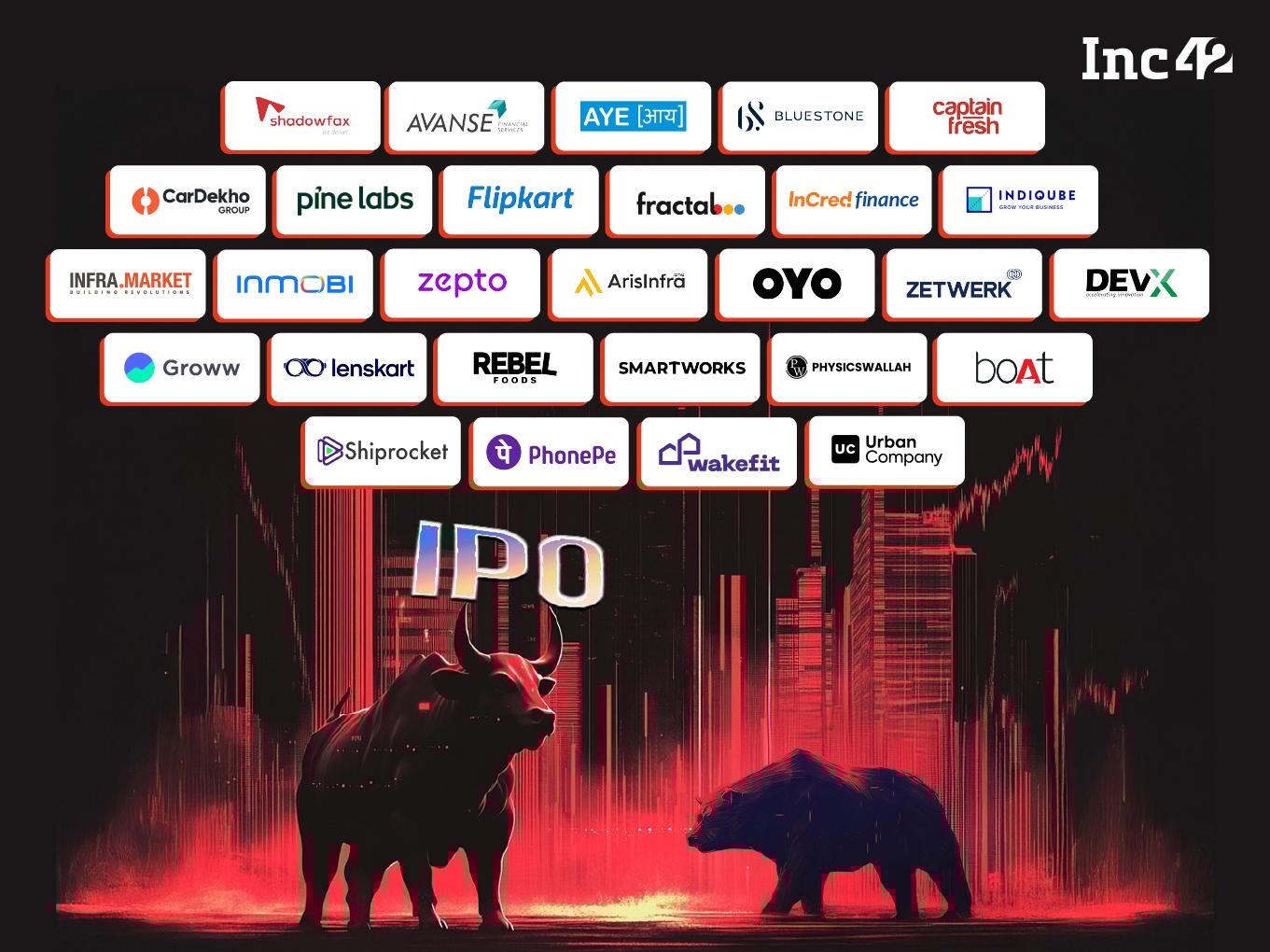
At the start of 2025, markets were brimming with optimism about new-age tech IPOs. Thirteen startups hit Dalal Street last year, cumulatively raising INR 29,070 Cr via their public listings.
From sectoral giants like Swiggy and FirstCry to smaller players like TAC Infosec, their successful IPOs not only proved the mettle of these startups but also gave spectacular returns to their early investors (30X in some cases).
The investor confidence was further bolstered by increasingly rational valuations and the focus of Indian founders on sustainable profitability. Therefore, it was only natural for industry watchers to expect a booming year (2025) in terms of startup IPOs.
However, the IPO momentum ran into unexpected headwinds early in 2025. Despite multiple new-age tech companies filing their draft red herring prospectuses (DRHPs) and many receiving SEBI nod, just two listings – Ather Energy and Arisinfra – materialised in the first half of the year.
The reason? A correction in the Indian equities market caused by global geopolitical tensions, escalating tariff wars and cautious investor sentiment.
Even though the first half of the year remained muted for new-age tech IPOs, things have started to look up in the second half of the year. As many as five startups have already made their D-Street debuts since the start of July. However, not everyone was destined for an upbeat listing.
While BlueStone, DevX and IndiQube’s public market debuts remained lacklustre, Smartworks garnered a healthy response from investors. However, the star of the 2025 startup IPO season so far has been Urban Company, which shook the market by listing at 56.3% premium.
As the year approaches its end, the road ahead looks even more promising as 26 startups have so far filed their DRHPs with the SEBI. With all eyes on what’s going to unravel next, we have compiled a list of Indian new-age tech companies that plan to list on the exchanges this year and next.
But, before we dive into the list, here are the latest developments from the Indian IPO landscape:
Latest Updates:
- Omnichannel eyewear giant Lenskart’s IPO was oversubscribed 1.13X on the first day of bidding, receiving bids for 11.2 Cr shares as against 9.9 Cr shares on offer
- Fintech major Pine Labs’ public issue will open for subscription on November 7. Its IPO will comprise a fresh issue of up to INR 2,080 Cr and an OFS of up to 8.23 Cr shares
- Logistics major Shadowfax has filed its updated DRHP with SEBI for its IPO of up to INR 2,000 Cr
The companies have been listed in an alphabetical order | Data has been sourced from Inc42, respective DRHPs, MCA filings and other media reports | Asterisk (*) specifies reported numbers.
| Name | Founded In | Sector | Total Funding | Key Investors | Revenues | DRHP Status | IPO Size [₹Cr] | Potential Valuation [₹Cr] | Book Running Lead Managers |
| AceVector | 2010 | Ecommerce | – | SoftBank, eBay, Nexus Venture Partners | ₹379.8 Cr (FY24) | Filed | ₹500 Cr | NA | |
| Aequs | 2016 | Deeptech | $81 Mn | Avansa Capital, Amicus Capital, Steadview Capital, Catamaran, Sparta Group | ₹988.3 Cr (FY24) | Filed | ₹1,728 Cr* | NA | NA |
| Amagi | 2008 | SaaS | $320 Mn | General Atlantic, Accel, Norwest Venture Partners, Avataar Ventures, Premji Invest | ₹1,162.6 Cr (FY25) | Filed | ₹3,200 Cr* | NA | Kotak Mahindra Capital, Citigroup, IIFL Capital, Goldman Sachs |
| ArisInfra | 2021 | Ecommerce | $25 Mn | Siddharth Shah, Think Partners, Logx Venture Partners, Karbonite Ventures | ₹696.84 Cr (FY24) | Listed | ₹600 Cr | ₹1,799 Cr | JM Financial, IIFL Securities, Nuvama |
| Ather Energy | 2013 | Electric Vehicles | $431 Mn | Hero MotoCorp, GIC, Tiger Global | ₹2,255 Cr (FY25) | Listed | ₹2,980 Cr | ₹14,123 Cr | Axis Capital, Nomura, HSBC Securities and Capital, JM Financial Markets |
| Avanse Financial Services | 2013 | Fintech | $212 Mn | Warburg Pincus, Kedaara Capital, International Finance Corporation, Mubadala | ₹2,347 Cr (FY25) | Refiled | ₹3,500 Cr | NA | Kotak Mahindra Capital, Avendus Capital, JP Morgan, Nomura, Nuvama Wealth Management, SBI Capital Markets |
| Aye Finance | 2014 | Fintech | $485 Mn | Google, ABC Impact, FMO | ₹1,459.7 Cr (FY25) | Filed | ₹1,450 Cr | NA | Axis Capital, IIFL Capital Services, Nuvama, JM Financial |
| BlueStone | 2011 | D2C | $200 Mn | Accel, Kalaari Capital, Deepinder Goyal, and Nikhil Kamath | ₹1,770 Cr (FY25) | Listed | ₹1,540.65 Cr | ₹7,823 Cr | Axis Capital, IIFL Capital, Kotak Mahindra Capital |
| boAt | 2016 | D2C | $177 Mn | Qualcomm Ventures, Warburg Pincus | ₹3,118 Cr (FY24) | Filed | ₹2,000 Cr* | NA | ICICI Securities, Goldman Sachs, Nomura |
| Capillary Technologies | 2008 | SaaS | $239 Mn | Avataar Ventures, Filter Capital, Peak XV Partners | ₹598.3 Cr (FY25) | Filed | ₹2,250 Cr* | ₹4,321 Cr – ₹8,600 Cr | NA |
| Captain Fresh | 2019 | D2C | $172 Mn | Prosus, Tiger Global, Nekkanti Sea Foods, Shakti Finvest | ₹1,395 Cr (FY24) | Filed | ₹3,530 Cr | ₹11,192 Cr- ₹12,914 Cr | Axis Capital, Bank of America |
| CarDekho | 2008 | Auto tech | $692 Mn | Google Capital, Hillhouse Capital, Peak XV Partners, HDFC Bank | ₹2,250.43 Cr (FY24) | Yet To File | ₹4,100 Cr | ₹17,219 Cr- ₹21,524 Cr | NA |
| Cult.fit | 2016 | Ecommerce | $650 Mn | Zomato, Accel, Tata Digital, Temasek, Kalaari Capital | ₹926.6 Cr (FY24) | Yet To File | ₹2,500 Cr | ₹17,200 Cr | Axis Capital, Jefferies, Goldman Sachs, Morgan Stanley, JM Financial |
| Curefoods | 2020 | Foodtech | $175 Mn | Iron Pillar, Accel, Three State Ventures, Chiratae Ventures, ASK Finance | ₹745.8 Cr (FY25) | Filed | ₹2,582 Cr- ₹3,443 Cr | NA | NA |
| DevX | 2017 | Coworking | $13.3 Mn | Kalpesh Harakhchand Gala, Unmaj Corporation, Bidiwala Family Office | ₹158.9 Cr (FY25) | Listed | ₹143.35 Cr | ₹550.1 Cr | Pantomath Capital Advisors |
| Droom | Auto Tech | $300 Mn | Lightbox, 57 Stars, Seven Train Ventures | ₹85.4 Cr (FY24) | Yet To File | ₹1,000 Cr | ₹10,331 Cr- ₹12,914 Cr | NA | |
| Flipkart | 2007 | Ecommerce | NA | Walmart, Google | ₹20,493 Cr (B2C) (FY25) | Yet To File | Yet To Be Decided | NA | NA |
| Fractal | 2000 | SaaS | $685 Mn | TPG Capital, Khazanah Nasional, Apax Partners | ₹ 2,765.4 Cr (FY25) | Yet To File | ₹4,900 Cr | ₹25,828 Cr | NA |
| Groww | 2017 | Fintech | $393 Mn | Y Combinator, Tiger Global Management, Ribbit Capital, Alkeon, Steadfast | ₹3,145 Cr (FY24) | Filed | ₹8,600 Cr | ₹60,260 Cr- ₹68,877 Cr | Kotak Mahindra Capital, JP Morgan, Axis Capital, Citi, Motilal Oswal* |
| Imarticus Learning | 2012 | Edtech | $11.7 Mn | Global Ivy Ventures, Capian, BLinC Invest | ₹159 Cr (FY24) | Yet To File | ₹750 Cr | ₹5,000 Cr- ₹6,000 Cr | NA |
| InCred | 2016 | Fintech | $318 Mn | FMO, KKR, Paragon Partners, Varanium Capital | ₹1,270 Cr (FY24) | Yet To File | ₹4,000 Cr- ₹5,000 Cr | ₹15,000 Cr- ₹22,500 Cr | NA |
| IndiQube | 2015 | Coworking | $45 Mn | WestBridge Capital, MMPL Trust, Konark Trust | ₹1,059.3 Cr (FY25) | Listed | ₹700 Cr | ₹4,977 Cr | ICICI Securities, JM Financial |
| Infra.Market | 2016 | Ecommerce | $415 Mn | Tiger Global, Accel, Nexus Ventures | ₹14,530 Cr (FY24) | Yet To File | ₹4,304 Cr- ₹6,000 Cr | Yet To Be Decided | Kotak Mahindra Capital, IIFL Capital, Goldman Sachs, Jefferies |
| InMobi | 2007 | SaaS | $320 Mn | Sherpalo Ventures, SoftBank, Kleiner Perkins | ₹587 Cr (FY23) | Yet To File | ₹8,609 Cr | ₹68,877 Cr- ₹ 86,096 Cr | NA |
| Innoviti | 2002 | Fintech | $87 Mn | Random Walk Solutions, Bessemer Venture Partners, Patni Family Office India | ₹105.6 Cr (FY24) | Yet To File | Yet To Be Decided | Yet To Be Decided | NA |
| Kissht | 2015 | Fintech | $140 Mn | Vertex Growth, Zodius, Brunei Investment Agency, Endiya Partners | ₹1,337.5 Cr (FY25) | Filed | ₹1,000 Cr | ₹7,748 Cr- ₹9,470 Cr | ICICI Securities, UBS Securities, Motilal Oswal* |
| LEAP India | 2013 | Logistics | $184 Mn | KKR, Sixth Sense Ventures | ₹466.4 Cr (FY25) | Filed | ₹2,400 Cr | NA | UBS, Avendus Capital, IIFL, JM Financial |
| Lenskart | 2010 | Ecommerce | $1.78 Bn | SoftBank, ADIA, Temasek, Fidelity Investments, ChrysCapital | ₹6,652.5 Cr (FY25) | Filed | ₹2,150 Cr | ₹60,200 Cr-₹68.800 Cr | Kotak Mahindra Bank, Morgan Stanley |
| Licious | 2015 | Ecommerce | $555 Mn | Temasek, 3one4 Capital, Innoven Capital, Amansa Capital | ₹685.05 Cr (FY24) | Yet To File | NA | ₹17,200 Cr | NA |
| Meesho | 2015 | Ecommerce | $1.36 Bn | Tiger Global Management, Peak XV Partners, Meta, Locus Ventures, Y Combinator | ₹7,615 Cr (FY24) | Filed | ₹6,049 Cr-₹6,914 Cr | ₹17,200 Cr | Morgan Stanley, Kotak Mahindra Capital, Citi* |
| Moneyview | 2016 | Fintech | $190 Mn | Accel India, Nexus Ventures. | ₹1,012 Cr (FY24) | Yet To File | ₹3,457 Cr | NA | Axis Capital, Kotak Mahindra Capital Company |
| Navi | 2018 | Fintech | $677 Mn | Gaja Capital | ₹2,271.2 Cr (FY25) | Yet To File | NA | NA | NA |
| NoPaperForms | 2017 | SaaS | $4.5 Mn | Info Edge | ₹70 Cr (FY24) | Yet To File | ₹500 Cr- ₹600 Cr | ₹2,000 Cr | IIFL Capital, SBI Capital |
| OfBusiness | 2015 | Ecommerce | $879.61 Mn | Tiger Global, Norwest, Softbank, Matrix Partners, Falcon Edge | ₹19,296.3 Cr (FY24) | Yet To File | ₹6,360 Cr- ₹8,480 Cr | ₹51,650 Cr- ₹77,400 Cr | Axis Capital, Morgan Stanley, JPMorgan, Citigroup, Bank of America* |
| Ola Consumer | 2011 | Mobility | $3.84 Bn | SoftBank, Vanguard, Accel, Bessemer Venture Partners | ₹2,011.9 Cr (FY24) | Yet To File | ₹4,300 Cr | ₹43,000 Cr | NA |
| OYO | 2013 | Travel Tech | $3.47 Bn | Microsoft, Red Lions Capital, JP Morgan Chase, Qatar Insurance Company | ₹5,388.7 Cr (FY24) | To Be Refiled | ₹6.680 Cr* | NA | NA |
| PayNearby | 2016 | Fintech | $4 Mn | The Gain, BetaPlus Capital | ₹355 Cr (FY24) | Yet To File | NA | NA | NA |
| PayU India | 2002 | Fintech | NA | Prosus | $444 Mn (FY24) | Yet To File | ₹4,321 Cr* | Yet To Be Decided | Goldman Sachs, Morgan Stanley, Bank of America* |
| PhonePe | 2015 | Fintech | $2.29 Bn | Walmart, General Atlantic, Ribbit Capital, Tiger Global, TVS Capital Funds | ₹5,725 Cr (FY24) | Yet To File | Yet To Be Decided | NA | JP Morgan, Citi India, Morgan Stanley, Kotak Mahindra Capital* |
| Physics Wallah | 2020 | Edtech | $312 Mn | Hornbill Capital, Lightspeed, GSV Ventures, WestBridge Capital | ₹2,886.6 Cr (FY25) | Filed | ₹3,280 Cr | ₹24,107 Cr | Kotak Mahindra Capital, JP Morgan, Axis Bank, Goldman Sachs |
| Pine Labs | 1998 | Fintech | $1.59 Bn | Peak XV Partners, Temasek, Vitruvian Partners, Nordmann, Alpha Wave Global, SBI | ₹1,309.6 Cr (FY24) | Filed | ₹2,600 Cr (excluding OFS of up to 14.78 Cr shares) | ₹51,657 Cr | Axis Capital, Morgan Stanley, Citigroup, JP Morgan, Jefferies India* |
| Pure EV | 2015 | Electric Vehicles | $14 Mn | Bennett Coleman and Company, Hindustan Times Media Ventures, Ushodaya Enterprises | ₹131.3 Cr (FY23) | Yet To File | Yet To Be Decided | NA | NA |
| Purple Style Labs | 2015 | D2C | $78 Mn | Alchemy Capital Management, Bajaj Holdings and Investment, Minerva Ventures | ₹507.8 Cr (FY24) | Yet To File | ₹750 Cr (excluding OFS) | NA | NA |
| Razorpay | 2014 | Fintech | $816 Mn | Peak XV Partners, Z47, Lone Pine Capital, Alkeon Capital Management, TCV | ₹2,475 Cr (FY24) | Yet To File | NA | NA | NA |
| Rebel Foods | 2011 | Foodtech | $563 Mn | Coatue Management, Lightbox, Peak XV Partners | ₹1,420.2 Cr (FY24) | Yet To File | Yet To Be Decided | NA | NA |
| Servify | 2015 | Consumer Services | $130 Mn | BEENext, Blume Ventures, DMI Sparkle Fund, Iron Pillars | ₹754 Cr (FY24) | Yet To File | ₹3,400 Cr – ₹4,300 Cr | ₹12,914 Cr | NA |
| Shadowfax | 2015 | Logistics | $212 Mn | Flipkart, Mirae India, IFC, Nokia Growth Partners, Qualcomm | ₹1,884.8 Cr (FY24) | Filed | ₹2,500 Cr – ₹3,000 Cr | ₹5,000 Cr – ₹8,000 Cr | ICICI Securities, JM Financial, Morgan Stanley* |
| Shiprocket | 2017 | Logistics | $323 Mn | Temasek, Bertelsmann, Tribe Capital, Lightrock | ₹1,316 Cr (FY24) | Filed | ₹2,000 Cr – ₹2,500 Cr | NA | NA |
| Smartworks | 2016 | Coworking | $41 Mn | Ananta Capital, Keppel Land, Plutus Capital | ₹1,039.3 Cr (FY24) | Listed | ₹582.56 Cr | ₹5,080 Cr | JM Financial, BOB Capital Markets, IIFL Securities, Kotak Mahindra Capital |
| Square Yards | 2014 | Proptech | $200 Mn | Reliance Group, ADM Capital, BCCL, Genkai Capital | ₹1,400 Cr (FY25) | Yet To File | ₹2,000 Cr | ₹8,827 Cr | NA |
| Table Space | 2017 | Coworking | $407 Mn | Hillhouse Capital, Rava Partners, Alta Capital | ₹898 Cr (FY24) | Yet To File | NA | NA | NA |
| Tonbo Imaging | 2012 | Deeptech | $59 Mn | Artiman Ventures, Celesta Capital, Qualcomm Ventures | ₹460 Cr (FY25) | Yet To File | ₹800 Cr – ₹1,000 Cr | NA | IIFL Securities, JM Financial |
| Turtlemint | 2015 | Fintech | $197 Mn | Amansa Capital, Jungle Ventures, Peak XV Partners, Vitruvian Partners, Nexus Venture Partners | ₹674.5 Cr (FY25) | Filed | ₹1,700 Cr- ₹2,150 Cr | NA | Motilal Oswal, JM Financials, ICICI Securities, Jefferies |
| Urban Company | 2014 | Consumer Services | $646 Mn | Tiger Global, Prosus, Steadview Capital | ₹1,144.5 Cr (FY25) | Listed | ₹1,900 Cr | ₹14,790 Cr | Kotak Mahindra Capital, Goldman Sachs, Morgan Stanley |
| Wakefit | 2016 | D2C | $100 Mn | Peak XV Partners, Investcorp, Verlinvest, SIG | ₹986.35 Cr (FY24) | Filed | ₹468 Cr (excluding OFS of up to 5.8 Cr shares) | NA | Kotak Mahindra Capital, Goldman Sachs and Morgan Stanley* |
| WeWork India | 2017 | Coworking | NA | Ariel Way Tenant | ₹1,665.14 Cr (FY24) | Listed | OFS Comprising 4.3 Cr shares | NA | JM Financial, ICICI Securities, Kotak Mahindra Capital, Jefferies India, 360 ONE WAM |
| WonderChef | 2009 | D2C | $30 Mn | Sixth Sense Ventures, Amicus Capital, Godrej Family Office, Malpani Group | ₹377 Cr (FY24) | Yet To File | NA | ₹1,800 Cr | NA |
| Zappfresh | 2015 | D2C | $14.5 Mn | SIDBI Venture Capital, Gyan Dairy, ah! Ventures | ₹90 Cr (FY24) | Listed | Fresh Issue Of 59.06 Lakh shares | NA | Narnolia Financial Services |
| Zepto | 2021 | Quick Commerce | $1.60 Bn | Y Combinator, Goodwater Capital, Glade Brook Capital, General Catalyst, Dragon Fund | ₹4,454.52 Cr (FY24) | Yet To File | ₹6,914 Cr-₹8,600 Cr | Yet To Be Decided | Morgan Stanley, Goldman Sachs |
| Zetwerk | 2018 | Ecommerce | $793 Mn | Greenoaks Capital, Lightspeed, Mars Growth Capital, Peak XV Partners | ₹11,448.6 Cr (FY24) | Yet To File | ₹3,456 Cr-₹4,320 Cr | ₹43,209 Cr | Axis Capital, Goldman Sachs, Jefferies, JM Financial, JPMorgan Chase, Kotak Mahindra Bank |
Now, let’s take a detailed look at the list:
Startups That Have Taken The IPO Plunge In 2025
ArisInfra
Founded in 2021 by Ronak Morbia and Bhavik Khara, ArisInfra is a B2B ecommerce platform that utilises artificial intelligence (AI) to simplify procurement of construction materials. It links real estate developers with vendors for sourcing building materials, and also offers project management services.
Backed by Think Partners, Logx Venture Partners, PharmEasy cofounder and CEO Siddharth Shah, and Karbonite Ventures, the company has bagged more than $25 Mn in funding to date.
In August 2024, the company kicked off its IPO proceedings by filing its DRHP with SEBI to raise INR 600 Cr via its IPO. Its public issue was to comprise solely a fresh issue of shares, with no OFS.
Later, the company first trimmed the size of the fresh issue to INR 579.6 Cr and then to INR 499.6 Cr. It received approval from the market regulator for its public listing in November 2024.
In the run up to its IPO, ArisInfra raised INR 224.8 Cr from anchor investors, including the likes of Astorne Capital VCC, Niveshaay Hedgehogs Fund, and Nexus Global Opportunities Fund. Its public issue closed with an oversubscription of 2.65X, with investors bidding for 3.47 Cr shares as against 1.31 Cr shares on offer.
The company made a lacklustre stock market debut on June 25. ArisInfra’s shares listed at INR 205 on the NSE, a 7.65% discount over its issue price of INR 222. On the BSE, the stock debuted at INR 209, a 5.81% discount over its issue price.
ArisInfra’s consolidated net loss jumped 11.95% YoY to INR 17.33 Cr in FY24, while revenue from operations fell more than 6% YoY to INR 696.84 Cr during the fiscal under review. The company reported a net loss of INR 0.51 Cr in Q4 FY25, down 97% YoY, on an operating revenue of INR 221.1 Cr, up 7% YoY.
Ather Energy
Ather became the first listed Indian new-age tech company of 2025 to go public after it listed on the exchanges on May 6. The EV maker’s public issue saw a muted response as the shares opened at INR 328 on the NSE, a mere 2.18% premium over its IPO price of INR 321.
On the BSE, the stock opened at INR 326.05, a 1.57% premium over the IPO price. With this, it became the second EV startup in the country to go public, after Ola Electric.
Founded in 2013 by Tarun Mehta and Swapnil Jain, Ather is one of the biggest players in the Indian electric two-wheeler segment. It manufactures and services escooters and operates its own charging infrastructure.
The EV major raised more than $431 Mn in funding prior to its stock market debut from the likes of Hero MotoCorp, GIC, Tiger Global, among others.
The Bengaluru-based company’s public issue closed with an oversubscription of 1.43X in late-April 2025. The IPO received bids for 7.65 Cr shares as against 5.34 Cr shares on offer.
This marked the culmination of Ather’s year-long efforts to get listed on the exchanges. In September 2024, it filed its DRHP. As per its draft IPO papers, Ather’s public issue was to comprise a fresh issue of shares worth INR 3,100 Cr and an OFS component of up to 2.2 Cr equity shares.
In December 2024, the company received SEBI’s approval to go ahead with its IPO plans. Four months later in April 2025, the EV major filed its RHP with SEBI and trimmed the size of its IPO.
Ahead of the opening of the IPO, the company raised INR 1,340 Cr from 36 anchor investors, including SBI, ADIA, Invesco, Franklin Templeton, among others, at INR 321 apiece.
Ather managed to trim its net loss by 17% to INR 234.4 Cr in Q4 FY25 from INR 283.3 Cr in the year-ago period. Revenue from operations rose 29% to INR 676.1 Cr in the quarter under review from INR 523.4 Cr in the same period last year.
BlueStone
Founded in 2011 by Gaurav Singh Kushwaha and Vidya Nataraj, BlueStone is an omnichannel jewellery brand that sells rings, pendants, earrings and other products. Backed by Prosus, Steadview Capital and Think Investments, the startup has raised more than $184 Mn in funding till date.
Kicking off its IPO proceedings in August 2024, the jewellery startup raised INR 900 Cr as part of a pre-IPO funding round that catapulted its valuation to $970 Mn. Just four months later in December, the omnichannel jewellery brand filed its DRHP for an INR 1,000+ Cr IPO.
SEBI issued its observation letter to BlueStone to go ahead with the IPO on April 1, 2025.
Subsequently, the company filed its RHP, in which it trimmed the size of its fresh issue to INR 820 Cr from INR 1,000 Cr previously. It also slashed the size of its OFS component to 1.4 Cr shares from 2.4 Cr shares earlier.
The new-age jewellery brand had set a price range of INR 492 to INR 517 for its IPO. Subsequently, its public issue closed with an oversubscription of 2.7X.
However, BlueStone had a lacklustre stock market debut on August 19 and its shares listed at INR 508.80 apiece, a discount of 1.5% to the issue price of INR 517. On the NSE, the stock opened 1.3% lower from the issue price at INR 510.
On the financial front, BlueStone’s net loss widened 56% to INR 221.8 Cr in FY25 from INR 142.2 Cr in the previous year. Operating revenue zoomed 39.9% to INR 1,770 Cr during the fiscal under review from INR 1,265.8 Cr in FY24.
DevX
Founded in 2017 by Parth Shah, Rushit Shah and Umesh Uttamchandani, DevX offers coworking space solutions, managed office spaces, among others.
Backed by Kalpesh Gala, Unmaj Corporation, and Bidiwala Family Office, DevX operates coworking spaces in 11 Indian cities, including Ahmedabad, Vadodara, Bengaluru, Delhi, Surat, among others. It claims to cater to 250 clients including Zomato, Tim Hortons, Deakin University, among others.
The coworking company initially filed its DRHP with SEBI in September 2024 for a listing on the NSE and the BSE. However, in February 2025, SEBI returned the DRHP for unspecified reasons. Subsequently, the company refiled its DRHP with the markets regulator in April 2025.
It received SEBI’s nod for an IPO in August 2025. Its IPO solely comprised a fresh issue of 2.35 Cr shares. The startup set a price band of INR 56 to INR 61 per share for its public issue.
Ahead of the public issue, the coworking space provider raised INR 63.2 Cr by allotting over 1 Cr equity shares to 11 anchor investors. Subsequently, its public issue closed with an oversubscription of 63.97X as investors bid for 84.1 Cr shares as against 1.32 Cr shares on offer.
Eventually, the coworking space provider’s shares made a muted debut on the stock exchanges, listing at INR 61.30 on the BSE compared to its issue price of INR 61. On the NSE, the stock listed flat at INR 61.
DevX clocked a net profit of INR 1.7 Cr in FY25, a 3X jump from INR 43.3 Lakh in the previous fiscal year. Meanwhile, operating revenue jumped 47% to INR 158.9 Cr from INR 108.1 Cr in FY24.
IndiQube
Founded in 2015 by Rishi Das and Meghna Agarwal, IndiQube is a coworking space provider that offers workspace design, interior build out and other B2B and B2C-focussed services.
Backed by WestBridge Capital, Aravali Investment Holdings, and Konark Trust, IndiQube raised more than $45 Mn in funding across multiple rounds before it came out with its IPO.
Kicking off its IPO proceedings, the Bengaluru-based company turned into a public limited company in December 2024. Initially, it filed its DRHP with SEBI for an INR 850 Cr IPO. In March 2025, SEBI greenlit the coworking space startup’s IPO.
Subsequently, in its RHP, the company trimmed the size of its public issue by INR 150 Cr to INR 700 Cr. The IPO comprised a fresh issue of shares worth INR 650 Cr and an OFS of INR 50 Cr.
Ahead of the IPO, the workspace solutions provider raised INR 314 Cr by allotting 1.3 Cr equity shares to anchor investors INR 237 apiece. Subsequently, its public issue closed with an oversubscription of 12.4X, with investors bidding for 21.2 Cr shares as against 1.71 Cr shares on offer.
However, IndiQube had a lacklustre market debut. Shares of the workspace solutions provider listed at INR 218.7 apiece on the BSE, down 7.7% from the issue price of INR 237. On the NSE, it listed at INR 216, a discount of 8.8% over its issue price.
IndiQube’s net loss declined 60% to INR 139.6 Cr in FY25 from INR 341.5 Cr in the previous fiscal. However, revenue from operations jumped 28% to INR 1,059.3 Cr during the year under review from 830.6 Cr in FY24.
Smartworks
Founded in 2016 by Neetish Sarda and Harsh Binani, Smartworks is a shared workspace provider that offers customisable coworking solutions for enterprises. The startup has raised $41 Mn in funding till date and is backed by the likes of Ananta Capital, Keppel Land and Plutus Capital.
Taking the first step towards its IPO, the startup turned into a public company in July 2024 and then filed its DRHP with SEBI for INR 550 Cr IPO in August 2024. It received approval from the markets regulator for its listing in December 2024.
More than seven months after the market regulator’s nod, Smartworks filed its RHP in July 2025. The coworking startup trimmed the size of its fresh issue to INR 445 Cr from INR 550 Cr previously. It also almost halved the size of the OFS component to up to 33.79 Lakh shares from 67.49 Lakh shares earlier.
Smartworks raised INR 173.64 Cr from anchor investors. Its public issue closed with an oversubscription of 13.45X, with investors bidding for 13.9 Cr shares as against 1.04 Cr shares on offer.
Subsequently, on July 17, Smartworks made its stock market debut. The stock debuted at INR 436.10 on the BSE, a premium of 7.14% over the issue price of INR 407. On the NSE, shares of the company opened at INR 435, a 6.88% premium over the issue price.
On the financial front, the company’s net loss jumped 26.5% to INR 63.2 Cr in FY25 from INR 49.9 Cr in the previous year. Operating revenue jumped 32.3% to INR 1,374.1 Cr during the year under review from INR 1,039.3 Cr in FY24.
Urban Company
Founded in 2014 by Abhiraj Singh Bahl, Raghav Chandra, and Varun Khaitan, Urban Company is a hyperlocal services startup that offers a range of services such as home cleaning, appliance salon and massage, repair services, painting, among others.
Backed by Tiger Global, Prosus and Steadview Capital, the Delhi NCR-based startup has raised more than $646 Mn in funding to date.
In February 2025, the Gurugram-based home services marketplace’s board approved a resolution to turn the company into a public entity. In April 2025, the company filed its draft red herring prospectus for INR 1,900 Cr public issue. It received SEBI’s approval for its IPO in August.
The IPO, which opened on September 10, comprised a fresh issue of shares worth INR 472 Cr and an OFS component of INR 1,428 Cr. The consumer services unicorn set a price band of INR 98 to INR 103 for its IPO.
The public issue closed on September 12 with an oversubscription of a whopping 103.63X, receiving bids for 1,106.45 Cr shares against 10.67 Cr shares on offer.
The company made a stellar debut on the bourses on September 17, listing 56.3% above their issue price at INR 161 apiece on the BSE. On the NSE, the stock listed at INR 162.25 per share, a premium of 57.5% over the issue price of INR 103.
On the financial front, Urban Company minted a net profit of INR 239.7 Cr in FY25 against a net loss of INR 92.7 Cr in the year ago fiscal. Operating revenue rose 38% YoY to INR 1,144.5 Cr during the year under review.
Meanwhile, the company clocked a profit of INR 6.9 Cr in Q1 FY26 on an operating revenue of INR 367.3 Cr.
WeWork India
Karan Virwani brought WeWork to India in 2017 through a partnership with his family’s Embassy Group. The coworking major operates over 68 centres spanning across eight cities in India, including Mumbai, Delhi NCR, Bengaluru, among others. These centres include over 1.14 Lakh desks and 8 Mn square feet of space.
In February 2025, the company filed its DRHP with SEBI. Three months later in July 2025, the capital markets regulator gave its nod to the company to launch its IPO.
WeWork India’s public issue consisted solely an OFS of up to 4.62 Cr equity shares. Of these, promoter group Embassy Buildcon LLP sold 3.54 Cr shares, while Ariel Way Tenant offloaded 1.08 Cr shares.
The coworking giant set a price band of INR 615 to INR 648 for its IPO, which opened on October 3 and closed on October 7. In total, WeWork India’s public offering was oversubscribed 1.15X, receiving bids for 2.92 Cr shares against 2.54 Cr shares on offer.
Shares of the coworking space provider eventually made a flat debut and listed at INR 646.5 on the BSE, marginally lower than the issue price of INR 648. On the NSE, the shares opened slightly above the issue price at INR 650.
The IPO-bound coworking startup reported a profit after tax (PAT) of INR 128.2 Cr in FY25 as against a loss of INR 135.7 Cr in the previous fiscal year. Its operating revenue rose 17% to INR 1,949.2 Cr during the fiscal under review from INR 1,665.1 Cr in FY24.
In Q1 FY26, WeWork India’s net loss stood at INR 14.1 Cr, down 51% YoY, as against an operating revenue of INR 535.3 Cr, up 19% YoY.
Zappfresh
Founded in 2015 by Deepanshu Manchanda and Shruti Gochhwal, Zappfresh is a D2C meat startup that supplies meat from farms to customers within 90 minutes.
Taking its first step towards IPO, the startup converted into a public entity in April 2024 after dropping “private” from its name. It changed its name to DSM Fresh Foods Ltd from DSM Fresh Foods Pvt Ltd previously.
It filed its DRHP for listing on BSE SME in August 2024. Ahead of the listing, the D2C startup also raised INR 16.8 Cr from anchor investors.
However, Zappfresh’s IPO was marred by weak investor interest. Initially, the company’s public issue was slated to close on September 30 but was extended till October 6 as the offering saw a subscription of just 52%. To entice investors, the company also reduced its IPO price band to INR 95-100 from INR 96-101 earlier.
The public issue finally closed with an oversubscription of 1.36X, with investors bidding for 53.12 Lakh shares as against 39.08 Lakh shares on offer. Zappfresh finally listed on BSE SME at INR 120, a premium of 20% over its issue price of INR 100.
On the financial front, it reported a net profit of INR 9.1 Cr in FY25, up 94% from INR 4.7 Cr in the previous fiscal year. Meanwhile, operating revenue surged more than 45% to INR 130.7 Cr in the fiscal under review from INR 90.4 Cr in FY24.
Startups That Have Filed DRHP
AceVector
A brainchild of Kunal Bahl and Rohit Bansal, AceVector’s genesis lies in the founding of ecommerce platform Snapdeal in 2010. Since then, the umbrella entity has grown to also include listed ecommerce enablement platform Unicommerce and house of brands platform Stellaro Brands.
The three entities were consolidated under a single group brand, AceVector, in 2022. Three years later, AceVector now wants to go public.
In July 2025, the consolidated entity filed its DRHP for an INR 500 Cr IPO, which will primarily comprise a fresh issue of shares.
As per Tofler, AceVector clocked revenue to the tune of INR 379.8 Cr in FY24, up a marginal 2.1% from INR 372 Cr in the previous year. It managed to trim its net loss by 43% to INR 160.4 Cr in the fiscal under review compared to INR 282.2 in FY23.
Aequs
A brainchild of Aravind Melligeri, Aequs is a contract manufacturing company that offers a range of integrated high-precision engineering services including forging, precision machining, surface treatment and aerostructure assembly and testing for the aerospace industry as well as consumer electronics companies.
Founded in 2016, it operates a diversified and vertically-integrated manufacturing platform, which is focussed on exports. It caters to giants like Apple, Airbus, Boeing, Safran, Dassault, Collings Aerospace, among others. Alongside, it also claims to have built India’s first global-scale toys manufacturing ecosystem, the Koppal Toy Manufacturing Cluster, in Karnataka.
Till date, Aequs has raised more than $81 Mn in funding and is backed by the likes of Avansa Capital, Amicus Capital, Steadview Capital, Catamaran (the family office of Infosys founder Narayana Murthy), Sparta Group, among others.
Kicking off its IPO proceedings, Aequs’ board, in April 2025, gave its nod to change the name of the company to ‘Aequs Limited’ from ‘Aequs Private Limited’.
In June 2025, the Karnataka-based contract manufacturing company filed its DRHP with SEBI via the confidential pre-filing route for a $200 Mn IPO. It received SEBI’s nod to float its IPO in late-September 2025.
As per its updated DRHP, the contract manufacturing company’s public offering will comprise a fresh issue of equity shares worth up to INR 720 Cr and an OFS component of up to 3.2 Cr equity shares.
The company plans to utilise the fresh proceeds from the IPO to repay outstanding borrowings for its subsidiaries, purchase new equipment, fuel unidentified acquisitions and for general corporate purposes.
On the financial front, the aerospace parts maker’s consolidated net loss zoomed 6X to INR 102.5 Cr in FY25 from INR 14.2 Cr in the previous fiscal. Meanwhile, operating revenue grew more than 18% to INR 988.3 Cr during the fiscal year under review from INR 836.2 Cr in FY24.
Amagi
Founded in 2008 by Baskar Subramanian, Srinivasan KA and Srividhya Srinivasan, Amagi offers a full stack cloud suite for clients to create, distribute and monetise content globally. It also offers broadcast and targeted advertising solutions for broadcast and streaming TV platforms.
It claims to support over 800 content brands, 800 playout chains and 5,000 channel deliveries via its platforms in over 150 countries, and has presence in cities such as New York, Los Angeles, Toronto, London, among others.
The SaaS unicorn’s IPO plans first came to light in January 2025 when a report claimed that the company had roped in Kotak Mahindra Capital, Citigroup, IIFL Capital and Goldman Sachs as investment bankers to helm its public issue.
Subsequently in May 2025, it converted into a public entity after the company’s board passed a special resolution to change its name to “Amagi Media Labs Limited” from “Amagi Media Labs Private Limited” previously.
After much ado, the media-focused SaaS unicorn filed its DRHP in July 2025 for its IPO, which will comprise a fresh issue of shares worth up to INR 1,020 Cr and an OFS component of up to 3.41 Cr shares.
On the financial front, Amagi’s consolidated net loss declined 72% to INR 68.7 Cr Cr in FY25 from INR 245 Cr in the previous fiscal year. Revenue from operations jumped 32.2% to INR 1,162.6 Cr from INR 879 Cr in FY24.
Avanse Financial Services
Founded in 2013, Avanse is a non-banking financial company (NBFC) that offers education financing for students and educational institutions in India. Its products also cater to students looking to study abroad and in India.
The company filed its DRHP in June 2024 for an INR 3,500 Cr IPO. The IPO will comprise a fresh issue of INR 1,000 Cr and an OFS component of shares worth up to INR 2,500 Cr.
In July 2024, SEBI returned the non-bank lender’s DRHP on “technical grounds”. A month later, the company refiled its draft IPO papers with the market regulator. Subsequently, SEBI gave its nod to the NBFC for the IPO in October 2024.
In August 2025, it was reported that the NBFC was mulling delaying its IPO plans amid slowing loan demand due to stricter US visa rules.
Backed by the likes of Warburg Pincus, International Finance Corporation (IFC), Mubadala Investment Company and Kedaara Capital, the startup has reportedly raised more than $299 Mn in funding to date.
The NBFC clocked a net profit of INR 502 Cr in FY25, up 46.6% from INR 342.4 Cr in the previous fiscal year. Operating revenue also grew to INR 2,347 Cr in the fiscal under review from INR 1,727 Cr in FY24.
AVPL International (AITMC Ventures)
Founded in 2016 by Preet Sandhuu and Deep Sisai, AITMC operates at the intersection of agriculture and drones. The startup manufactures drones, offers drone-as-a-service and operates over 70 drone training centres across 16 states.
Kicking off its IPO proceedings in July 2025, the startup’s board approved a proposal to increase the size of its IPO fresh issue to INR 200 Cr from INR 125 Cr earlier. Thereafter, the company also approved the appointment of Kamal Jeet Dahiya as a non-executive, independent director on its board.
Subsequently in October 2025, the dronetech startup filed its DRHP with the SEBI via the confidential pre-filing route.
This is the second time that AITMC is attempting to list on the exchanges. In December 2023, it filed its DRHP with SEBI for an NSE Emerge public offering, which was to comprise solely of fresh issue of up to 2.1 Cr shares.
However, the plan was later put on the back burner as AITMC signed a term sheet for a “strategic company merger” with BSE SME-listed DroneAcharya in January 2025. However, the merger failed to materialise.
On the financial front, AITMC Ventures’ net profit rose 59% to INR 14 Cr in FY25 as against INR 8.8 Cr in the previous fiscal. Operating revenue surged 87% to INR 87.5 Cr from INR 46.8 Cr in FY24.
Aye Finance
A brainchild of Sanjay Sharma and Vikram Jetley, Aye Finance was founded in 2014. The NBFC’s unique selling proposition (USP) lies in its AI-powered credit assessment algorithms that it leverages to offer loans to small businesses across the country.
The NBFC has secured $500 Mn in funding to date and counts the likes of Google, ABC Impact, Dutch entrepreneurial development bank FMO, among others, as investors. In the run up to its IPO
In December 2024, the NBFC filed its draft red herring prospectus with the SEBI for a public listing. The markets regulator greenlit the NBFC’s IPO plans on April 3, 2025.
As per the DRHP, Aye Finance’s IPO will comprise a fresh issue of shares worth INR 885 Cr and an OFS component of INR 565 Cr.
The IPO-bound NBFC’s net profit declined about 50% YoY to INR 30.6 Cr in Q1 FY26, while revenue from operations grew 21% YoY to INR 407 Cr during the quarter under review.
boAt
Founded in 2016 by Aman Gupta and Sameer Mehta, boAt is a D2C brand that sells products such as headphones, smart watches and speakers.
The startup has raised more than $171 Mn across multiple rounds from marquee names such as Warburg Pincus,Qualcomm Ventures, Malabar Investments, Innoven Capital, Fireside Ventures, among others.
boAt has been planning its IPO for some years now. In 2022, it filed its DRHP with SEBI in 2022 for an INR 2,000 Cr public issue but later shelved the plan amid adverse macroeconomic conditions.
Taking another attempt at its IPO, the company’s parent Imagine Marketing filed its DRHP via the confidential pre-filing route in April this year. The company received SEBI’s approval for its IPO in August.
The consumer electronics startup subsequently filed its updated DRHP with SEBI in October for up to INR 1,500 Cr IPO, which will comprise a fresh issue of equity shares worth up to INR 500 Cr and an OFS component of up to INR 1,000 Cr.
On the financial front, boAt was back in the black in FY25 and reported a net profit of INR 60.4 Cr as against a loss of INR 73.7 Cr in the previous fiscal. Its operating revenue, however, declined a marginal 1% to INR 3,073.3 Cr in the fiscal under review from INR 3,117.7 Cr in FY24.
boAt saw its revenue from operations rise 10.7% YoY to INR 628.1 Cr in Q1 FY26. The company also turned profitable during the quarter, posting a profit of INR 21.3 Cr as against a loss of INR 31 Cr in Q1 FY25.
Capillary Technologies
Founded in 2008 by Aneesh Reddy, Capillary Technologies is a SaaS startup that offers end-to-end customer engagement tools for brands to increase customer retention via personalised omnichannel communication. It also offers a customer data platform and reward network.
With presence spanning India, Southeast Asia, MENA, and the US, the company has raised more than $239 Mn in funding to date. It is backed by the likes of marquee names such as Avataar Ventures, Filter Capital, Peak XV Partners, among others.
The SaaS startup first attempted to list on the exchanges in 2021, when it filed its DRHP to raise $114 Mn via its market debut. However, the company later postponed the plans amid roiling market volatility and the onset of funding winter.
In May 2025, the SaaS startup received approval from its board to raise INR 2,250 Cr through its IPO. A month later in June 2025, the company refiled its DRHP with the SEBI to list on NSE and BSE.
The SaaS major received SEBI’s approval to float its IPO in September.
As per the DRHP, Capillary’s IPO will consist of a fresh issue of INR 430 Cr and an OFS component of 18.3 Mn shares. Under the OFS, investors including Ronal Holdings, Trudy Holdings, Filter Capital India, Sripathi Venkata Ramana Reddy, among others will offload their stakes.
The SaaS platform plans to utilise the proceeds from the IPO to build up its cloud infrastructure, invest in research, design and development of its products and platform, purchase computer systems, acquire companies and for general corporate purposes.
The IPO-bound SaaS company turned profitable after a span of three fiscal years in FY25 with a profit after tax (PAT) of INR 13.3 Cr against a loss of INR 59.4 Cr in FY24. It clocked an operating revenue of INR 598.3 Cr during the year under review, up 14% from INR 525.1 Cr in FY24.
Captain Fresh
Founded in 2019 by Utham Gowda, Captain Fresh is a B2B startup that exports and sells fish and seafood. Besides operating a marketplace for fisherfolk to sell their catch, it also offers an end-to-end operations management tool for retail outlets and supermarket chains for sale of seafood.
Backed by the likes of Tiger Global, Prosus and British International Investment (BII), the B2B startup has raised more than $172 Mn in funding to date.
Taking the first official step towards its public listing, Captain Fresh, in July 2025, turned into a public entity after its board approved a resolution to drop the word “private” from its name. Subsequently, in October, it was reported that Captain Fresh had roped in Axis Capital and Bank of America (BofA) as bankers to helm its planned IPO in the second half of 2025.
In August 2025, Inc42 reported that the B2B seafood startup filed its DRHP via the confidential pre-filing route for a $400 Mn IPO. The public issue will comprise a fresh issue of $200 Mn and an offer for sale of $150 Mn to $200 Mn. Previous reports suggested that the startup was eyeing a valuation of $1.3 Bn to $1.5 Bn for the IPO.
Captain Fresh had posted a revenue of INR 1,395 Cr in FY24 and posted a loss of INR 229 Cr. Meanwhile, sources said that the startup turned profitable and clocked a net profit of INR 40 Cr on a revenue of INR 3,200 Cr in FY25.
Curefoods
Founded in 2020 by Ankit Nagori, Curefoods is a cloud kitchen unicorn that operates a diverse portfolio of brands including EatFit, CakeZone, Nomad Pizza, Sharief Bhai Biryani, and Frozen Bottle.
It claims to manage more than 200 cloud kitchens and offline outlets across 15 cities in India, offering over 10 cuisines. The startup has raised more than $175 Mn in funding to date and is backed by names such as Iron Pillar, Accel, Three State Ventures, Chiratae Ventures, ASK Finance, among others.
In May 2025, the Bengaluru-based cloud kitchen startup converted into a public entity ahead of its IPO. Its board passed a resolution to change its name to ‘Curefoods India Limited’ from ‘Curefoods India Private Limited’.
In late-June 2025, the company filed its DRHP with SEBI to list on the exchanges. It received the market regulator’s nod for its IPO in late October 2025.
As per its draft IPO papers, Curefoods’ public issue will comprise a fresh issue of shares worth up to INR 800 Cr and an OFS of up to 4.85 Cr equity shares.
Existing backers Iron Pillar, Crimson Winter, Accel, Chiratae Ventures, Global eCommerce Consolidation Fund, Alteria Capital and others will sell their shares via the OFS. Notably, as per the DRHP, cloud kitchen major is also facing multiple criminal cases and allegations of child labour.
In September 2025, the cloud kitchen company bagged INR 160 Cr in its pre-IPO placement from Flipkart cofounder Binny Bansal’s 3State Ventures. It allotted 1.28 Cr equity shares to the VC firm at INR 124 per share.
On the financial front, the company’s net loss remained flat at INR 169.9 Cr in FY25 as against INR 172.6 Cr in the previous fiscal year. Meanwhile, operating revenue rose 27.4% to INR 745.8 Cr during the fiscal year under review from INR 585.1 Cr in FY24.
Fractal Analytics
Founded in 2000 by Srikanth Velamakanni, Pranay Agrawal and Ashwath Bhat, Fractal is a SaaS unicorn that offers AI and advanced analytics solutions to enterprises globally.
Backed by TPG Capital, Khazanah Nasional and Apax Partners, it has raised $685 Mn in funding till date. It turned unicorn in 2022 and was last valued at over $2 Bn.
As per Fractal’s annual report for FY24, it converted into a public company from a private company in May 2024.
In August 2025, the 3, which will comprise a fresh of shares worth up to INR 1,279.3 Cr and an OFS component of up to INR 3,620.7 Cr.
It plans to utilise the fresh proceeds from the IPO to repay or prepay the borrowings of its US-based subsidiary, set up a new office in India, fuel R&D and boost sales and marketing initiatives.
As per its DRHP, Fractal reported a net profit of INR 220.6 Cr in FY25 as against a net loss of INR 54.7 Cr in the previous year. Operating revenue jumped nearly 26% to INR 2,765.4 Cr during the year under review from INR 2,196.3 Cr in FY24.
Groww
Founded in 2017 by Lalit Keshre, Harsh Jain, Neeraj Singh, and Ishan Bansal, Groww is an online discount broking platform that allows users to invest in stocks, ETFs and other financial instruments.
In preparation for its IPO, Groww shifted its domicile back to India in March 2024. It also paid a hefty INR 1,340 Cr in taxes to US authorities to reverse flip back to India.
In January 2025, reports surfaced that Groww had finalised five investment banks – Kotak Mahindra Capital, JP Morgan, Axis Capital, Citi and Motilal Oswal – to helm its public listing. A few months later in May 2025, the investment tech major filed its draft IPO papers with markets regulator SEBI via the confidential pre-filing route.
The company received approval from SEBI to float its public issue in August. In October, the fintech unicorn filed its RHP with SEBI for its INR 6,600 Cr IPO, which will comprise a fresh issue of shares worth up to INR 1,060 Cr and an OFS component of up to 55.7 Cr shares.
Its public issue will now open on November 4 and close on November 7. The investment tech unicorn has also set a price band of INR 95 to INR 100 per share for its public listing. At the upper end of the price band, the company would be valued at INR 61,735 Cr (about $7 Bn).
On the financial front, Groww turned profitable in FY25 and reported a net profit of INR 1,824.4 Cr in FY25 compared to a loss of INR 805.5 Cr in the previous fiscal. Operating revenue jumped 50% to INR 3,901.7 Cr from INR 2,609.3 Cr in FY24.
Meanwhile, the company’s net profit rose 11% YoY to INR 378.4 Cr in Q1 FY26 against an operating revenue of INR 904.4 Cr, down 10% YoY.
Infra.Market
Founded in 2016 by Souvik Sengupta and Aaditya Sharda, Infra.Market operates a B2B marketplace that sells construction products and other range of building materials such as concrete, steel, pipes, fittings, and chemicals.
The startup has raised over $415 Mn in funding to date and is backed by marquee investors such as Tiger Global, Accel, and Nexus Ventures.
In October 2025, the company filed its draft IPO papers with the SEBI via the confidential pre-filing route in October.
It is looking to raise around INR 5,000 Cr ($563.3 Mn) via its IPO, which will have equal parts of fresh issue and OFS component.
The B2B ecommerce major’s net profit zoomed 144% YoY to INR 378 Cr in FY24, while operating revenue soared 23% YoY to INR 14,530 Cr during the fiscal under review.
Kissht
Founded in 2015 by Ranvir Singh and Krishnan Vishwanathan, Kissht is a digital lending platform which offers personal and business loans of up to INR 5 Lakh. It leverages AI and machine learning algorithms to assess creditworthiness of customers. In addition, it also offers health-related insurance products and loans against property.
The startup was valued at $344 Mn during its last fundraise of $80 Mn in 2022. Kissht has raised more than $140 Mn in funding to date and counts the likes of Vertex Growth, Brunei Investment Agency, Endiya Partners, and Ventureast among its backers.
At the end of March 2025, the company had more than 5.3 Cr registered users and INR 4,086.6 Cr in assets under management.
In June 2025, the fintech startup turned into a public entity. Following the move, the name of the company’s parent changed to OnEMI Technology Solutions Limited from OnEMI Technology Solutions Private Limited previously.
In August 2025, the lending tech startup filed its DRHP with SEBI to raise up to INR 1,000 Cr via the fresh issue. Its IPO will also comprise an OFS component of up to 88.8 Lakh shares, which will see existing backers Vertex Ventures, Endiya Partners, Ventureast and others pare their stakes.
The startup plans to utilise the fresh funding to augment the capital base of its NBFC subsidiary, Si Creva Capital, and for general corporate purposes.
On the financial front, Kissht’s consolidated net profit declined 18% to INR 160.6 Cr in FY25 from INR 197.3 Cr in the previous year. Operating revenue declined 20% to INR 1,337.5 Cr from INR 1,674.5 Cr in FY24.
LEAP India
Founded in 2013 by Sunu Mathew, LEAP India offers supply chain solutions via asset pooling, which allows companies to pool in their assets such as pallets and containers for use by multiple companies. It provides other services such as inventory management platform, transportation, returnable packaging, and repair and maintenance of tools and assets, among others. It also sells electric and fossil fuel-powered forklift trucks via its subsidiary TRON.
The company has raised more than $184 Mn since its inception and is backed by the likes of KKR and Sixth Sense Ventures.
In July 2025, reports surfaced that it had roped in UBS, Avendus Capital, IIFL and JM Financial as the lead managers for its upcoming IPO. In the same month, the company turned into a public entity and appointed Sanjiv Gupta and Harinarayan Nair as independent directors to its board.
A month later in August, the supply chain solutions provider filed its DRHP with the SEBI to raise up to INR 2,400 Cr via its IPO. The company’s public issue will comprise a fresh issue of shares worth INR 400 Cr and an offer for sale component of up to INR 2,000 Cr.
LEAP India plans to use the fresh proceeds from the IPO for repayment of borrowings (about INR 300 Cr) and for general corporate purposes.
Notably, this is LEAP India’s second stab at a public listing. In 2022, it was looking to raise about INR 1,000 Cr via public listing but postponed the plans amid market volatility.
LEAP India clocked an operating revenue of INR 466.4 Cr in FY25, up 27.8% from INR 364.9 Cr in the previous fiscal year. Meanwhile, net profit remained flat at INR 37.5 Cr in the fiscal under review as against INR 37.1 Cr in FY24.
Lenskart
Founded in 2010 by Peyush Bansal, Amit Chaudhury, and Sumeet Kapahi, Lenskart is an omnichannel eyewear retailer that caters to customers in India, the UAE, Singapore, Japan, among others.
The company claims to have over 2,723 stores and a customer base of 2 Cr. The Gurugram-based company has raised more than $1.75 Bn in funding to date from the likes of ChrysCapital, Abu Dhabi Investment Authority (ADIA), Temasek, among others.
Jumping on the IPO bandwagon, the eyewear giant, in January 2025, reportedly roped in Kotak Mahindra Bank and Morgan Stanley to helm the IPO.
In late-May, the omnichannel eyewear giant’s board passed a special resolution to change the name of the company to “Lenskart Solutions Limited” from “Lenskart Solutions Private Limited” previously.
Subsequently, in July 2025, Lenskart filed its DRHP with SEBI to raise up to INR 2,150 Cr via fresh issue of shares. In early October 2025, the company received SEBI’s nod to undertake its IPO. Weeks later, the company filed its RHP with SEBI for an IPO, which comprised a fresh issue of shares worth INR 2,150 Cr and an OFS component of up to 12.76 Cr equity shares.
Subsequently, the eyewear giant set a price band of INR 382 to INR 402 for its IPO and raised INR 3,268.4 Cr from anchor investors ahead of the commencement of the bidding.
Lenskart’s IPO opened to strong investor interest and was subscribed 1.13X on the first day of the public issue, receiving bids for 11.2 Cr shares as against 9.9 Cr shares available for subscription. The IPO will now close on November 4.
Lenskart turned profitable in FY25, reporting a profit of INR 297.3 Cr compared to a net loss of INR 10 Cr in the previous fiscal year. Revenue from operations rose 22.6% to INR 6,652.5 Cr in the fiscal under review from INR 5,427.7 Cr in FY24.
It also reported a net profit of INR 61.2 Cr in Q1 FY26 against an operating revenue of INR 1,894.5 Cr.
Meesho
Founded in 2015 by Vidit Aatrey and Sanjeev Barnwal, Meesho initially started off as a social ecommerce platform. But, in 2022, it pivoted to the marketplace model, taking on the giants like Flipkart and Amazon.
The ecommerce platform has raised close to $1.36 Bn in funding so far and was last valued at around $5 Bn.
In March 2025, reports surfaced that the company had shortlisted Morgan Stanley, Kotak Mahindra Capital and Citi as advisers for its IPO. In June 2025, the ecommerce giant’s board passed a resolution to convert into a public entity.
In June, the ecommerce major received approval from the National Company Law Tribunal (NCLT) to shift its headquarters back to India from the US. Days later, the startup’s board passed a resolution to merge its US-based entity Meesho Inc along with its India entity Meesho Ltd., thereby completing the reverse flip to India.As a part of this redomiciling process, Meesho is staring at tax liabilities north of $288 Mn (around INR 2,480 Cr).
In the same month, Meesho’s board also approved a proposal to raise up to INR 4,250 Cr (nearly $500 Mn) via fresh issue of shares as part of its IPO.
In July 2025, the ecommerce major filed its DRHP with markets regulator SEBI via the confidential pre-filing route. In October 2025, Inc42 reported that the company filed its updated DRHP with SEBI for an IPO, which will comprise a fresh issue of shares worth INR 4,250 Cr and an OFS component of 17.56 Cr shares.
Existing backers, including Elevation Capital, Peak XV Partners, Venture Highway and others, will offload their stakes as part of the OFS, while cofounders Vidit Aatrey and Sanjeev Kumar will also sell 1.1 Cr equity shares each.
On the financial front, the ecommerce unicorn’s operating revenue rose 23% to INR 9,389 Cr in FY25 compared to INR 7,615 Cr a year ago. Meanwhile, losses soared nearly 12X YoY to INR 3,914.7 Cr in the fiscal under review due to one-time tax liabilities related to reverse flipping. Excluding this, the startup’s loss stood at INR 108 Cr in FY25.
In 9M FY26, the startup reported an operating revenue of INR 2,503.8 Cr.
PhonePe
Founded in 2015 by Sameer Nigam, Rahul Chari and Burzin Engineer, PhonePe is India’s biggest online payments platform. It regularly accounts for nearly half of all Unified Payments Interface (UPI) transactions processed in the country.
From offering merely digital payments at the outset, the fintech giant has morphed into a full-fledged financial services platform, offering a host of offerings including insurance products, and broking services to customers.
The fintech major was acquired by ecommerce juggernaut Flipkart in 2016. Six years later, parent Walmart hived off PhonePe as a separate entity from Flipkart and redomicile the fintech company back to India. In late-2022, PhonePe flipped back to the country, with an eye on listing on Indian bourses.
Taking its first step towards public listing, the Walmart-owned digital payments giant, in April 2025, converted into a public company and changed its name to “PhonePe Limited” from “PhonePe Private Limited” earlier.
In September 2025, the Walmart-owned fintech giant filed its DRHP with the SEBI via the confidential pre-filing route. The company is looking to raise about anywhere between $1.2 Bn to $1.5 Bn at a nifty valuation of $12 Bn to $15 Bn.
Ahead of its IPO, existing backer General Atlantic, in October 2025, doubled down and picked up a stake worth $600 Mn (INR 5,304 Cr) in the fintech major via a secondary transaction. With this, the investment firm’s stake in PhonePe increased to about 9% from 4.4% earlier.
Its consolidated net loss narrowed 13.5% YoY to INR 1,727 Cr in FY25, while revenue soared 40.5% YoY to INR 7,115 Cr.
Physics Wallah
Founded in 2020 by Alakh Pandey and Prateek Maheshwari, Physics Wallah (PW) operates online and offline coaching centres for K-12 students and test preparation platforms for various exams. It also has a skilling arm and a study abroad vertical.
In March 2025, the edtech unicorn filed its DRHP via the confidential route for its public listing. In September, the company filed its updated DRHP with the markets regulator to raise INR 3,820 Cr through its IPO. The public issue will comprise a fresh issue of shares worth up to INR 3,100 Cr and an OFS component of up to INR 720 Cr.
Cofounders and promoters Pandey and Maheshwari, who together hold more than 80% stake in the company, plan to offload shares worth INR 360 Cr each under the OFS. If the plan fructifies, PW will become India’s first major edtech startup to list on the stock exchanges.
PW reported a net loss of INR 243.3 Cr in FY25, down 78.5% from INR 1,131 Cr in the previous fiscal year. Operating revenue jumped 49% to INR 2,886.6 Cr from INR 1,940.7 Cr in FY24.
Pine Labs
Founded in 1998 by Lokvir Kapoor, Rajul Garg, and Tarun Upadhyay, Pine Labs is a payment solutions provider that sells point of sales (PoS) devices and other payment systems to businesses. It also helps businesses deploy rewards and cashback solutions.
Pine Labs kickstarted its IPO proceedings in June 2024 as it began moving its domicile back to India. In November 2024, reports surfaced that the fintech major has shortlisted five investment banks – Axis Capital, Morgan Stanley, Citigroup, JP Morgan and Jefferies – to helm its IPO
In June 2025, the fintech unicorn filed the DRHP with the SEBI. The markets regulator greenlit the company’s IPO in September.
In October 2025, the fintech major filed its RHP for its IPO, which will comprise a fresh issue of up to INR 2,080 Cr and an OFS of up to 8.23 Cr shares. The IPO will open on November 7 and close on November 11, with shares expected to list on the exchanges on November 14.
Pine Labs reported a net loss of iNR 145.5 Cr in FY25, down 57.4% from INR 341.9 Cr in the previous fiscal year. Meanwhile, revenue from operations rose 28.5% to INR 2,274.3 Cr from INR 1,769.5 Cr in FY24.
In Q1 FY26, the company posted a net profit of INR 4.8 Cr in Q1 FY26 as against a net loss of INR 27.9 Cr in the year-ago quarter on the back of a one-time tax credit of INR 9.6 Cr. The fintech company’s operating revenue zoomed 17.8% YoY to INR 615.9 Cr during the quarter.
Purple Style Labs
Founded in 2015 by Abhishek Agarwal, Purple Style Labs operates an omnichannel luxury house of brands that counts fashion brands like Pernia’s Pop Up Studio & Shop, Wendell Rodricks, Hemant Trevedi in its portfolio.
It operates over 15 Pernia’s Pop-Up Studio experience centres in India and one in London.
Backed by the likes of Alchemy Capital Management, Bajaj Holdings and Investment and Minerva Ventures, the startup has raised more than $78 Mn in funding to date.
In August 2025, the startup’s board gave its nod to the company to undertake IPO proceedings. A month later, the D2C brand filed its DRHP with SEBI for an INR 660 Cr IPO. The public issue will comprise solely of a fresh issue of shares.
The fresh proceeds from the IPO will be utilised to open new outlets, ramp up its tech stack and bolster sales and marketing initiatives.
The company saw its operating revenue decline 3% to INR 489.9 Cr in FY25 from INR 504.3 Cr in the previous fiscal year. However, its net loss zoomed 4X to INR 188.6 Cr in the fiscal under review from INR 47.7 Cr in FY23.
Shadowfax
Founded in 2015 by Vaibhav Khandelwal and Abhishek Bansal, Shadowfax is a logistics startup that offers hyperlocal and on-demand deliveries to businesses.
The Flipkart-backed startup competes with the likes of Delhivery, Ecom Express, XpressBees, LoadShare, Ripple and Pickrr. It is also backed by the likes of Mirae Asset Venture Investments (India), IFC, Nokia Growth Partners, Qualcomm and Trifecta Capital.
Kicking off its IPO proceedings, the logistics startup turned into a public entity in March 2025 by dropping the word ‘private’ from its erstwhile name “Shadowfax Private Technologies Limited”.
In July 2025, the logistics startup filed its DRHP with SEBI through the confidential pre-filing route. The company also appointed ICICI Securities, JM Financial, and Morgan Stanley as the lead bankers for the IPO.
The logistics startup received SEBI’s nod to go ahead with its IPO in late-October 2025. It filed its updated DRHP with SEBI for its IPO in November 2025.
The startup’s public offering will comprise a fresh issue of equity shares worth up to INR 1,000 Cr and an OFS component of up to INR 1,000 Cr.
Shadowfax turned profitable in FY25 and posted a net profit of INR 6.4 Cr as against a net loss of INR 11.9 Cr in the previous fiscal year. Operating revenue rose 32% to INR 2,485.1 Cr from INR 1,884.8 Cr in FY24.
In H1 FY26, the company’s net profit soared more than 2X to INR 21 Cr from INR 9.8 Cr in H1 FY25. Operating revenue also zoomed 68.4% YoY to INR 1,805.6 Cr during the period under review.
Shiprocket
Founded in 2017 by Saahil Goel, Vishesh Khurana, Akshay Gulati, and Gautam Kapoor, Shiprocket aggregates third-party logistics companies. It partners with 17 courier partners, including Delhivery, FedEx, Aramex, Xpressbees, DTDC, and Shadowfax, and caters to customers across 24,000+ pin codes in India.
Backed by names such as Temasek, Bertelsmann, Tribe Capital, Lightrock, among others, Shiprocket has raised more than $323 Mn in funding to date.
Kicking off its IPO proceedings, the logistics unicorn’s board, in January 2025, passed a resolution to convert the startup into a public company from a private one.
In May, the Zomato-backed unicorn filed its DRHP with SEBI via the pre-filling route. In a newspaper ad, the company said that it proposes to list its shares, with a face value of INR 10 each, on the main board of the BSE and the NSE.
While the company has publicly not confirmed the size of its IPO, reports suggest that the logistics startup plans to raise INR 2,000 Cr to INR 2,500 Cr through the IPO. While INR 1,000 Cr to INR 1,200 Cr will be a fresh issue, the remaining would be raised via the OFS.
The company trimmed its net losses 87.5% YoY to INR 74.5 Cr in FY25, while revenues grew 24% YoY to INR 1,632 Cr in the fiscal under review.
Turtlemint
Founded in 2015 by Dhirendra Mahyavanshi and Anand Prabhudesai, Turtlemint operates an insurtech platform that helps financial advisors distribute insurance to their community of customers. The startup claims to have so far catered to more than 3 Lakh advisors across offerings such as car, bike, health, and term life insurance.
Backed by the likes of Amansa Capital, Jungle Ventures, Peak XV Partners, Vitruvian Partners and Nexus Venture Partners, the insurtech startup has raised more than $197 Mn in funding to date.
In April 2025, it was reported that Turtlemint was in talks with four bankers – Motilal Oswal, JM Financials, ICICI Securities and Jefferies – to launch its $200 Mn to $250 Mn IPO in late-2025.
Moving quickly, it filed its DRHP with SEBI via the confidential pre-filing route in September.
On the financial front, Turtlemint’s insurance arm slipped into the red in FY25 and posted a net loss of INR 47.1 Cr compared to a profit of INR 7.4 Cr in the previous year. However, operating revenue jumped 33.6% to INR 674.5 Cr from INR 505 Cr in FY24.
Wakefit
A brainchild of Ankit Garg and Chaitanya Ramalingegowda, Wakefit was founded in 2016. The D2C startup sells a range of products such as mattresses, pillows, bed frames, mattress protectors, home decor and furniture.
Backed by Peak XV Partners, Investcorp, Verlinvest, SIG, among others, Wakefit has raised more than $100 Mn since its inception. It competes with the likes of The Sleep Company, Duroflex, Kurlon and Sleepwell in the burgeoning Indian mattress and home decor market.
Kicking off its IPO proceedings in April 2025, the D2C startup shortlisted Axis Capital, IIFL Capital Services and Nomura as bankers for its IPO.
In June 2025, the Bengaluru-based D2C startup’s shareholders passed a special resolution to change its name to ‘Wakefit Innovations Limited’ from ‘Wakefit Innovations Private Limited’.
In June 2025, the D2C furniture and mattress startup filed its DRHP with the markets regulator SEBI to raise INR 468 Cr via fresh issue of shares. The IPO will also comprise an offer for sale of up to 5.8 Cr equity shares.
The startup received SEBI’s approval to float its IPO in October 2025.
As part of the OFS, the company’s cofounders and promoters Garg and Ramalingegowda, along with backers, including Peak XV Partners, Redwood Trust, Paramark and Verlinvest, among others, will offload shares via OFS route.
The company plans to utilise the proceeds from the IPO to expand its retail store network by setting up 117 new stores. A chunk of the capital will also be invested towards marketing initiatives.
On the financial front, Wakefit clocked a revenue INR 971 Cr from operations in the first nine months (9M) of FY25 against a net loss of INR 8.8 Cr.
In FY24, the company managed to trim its net loss by 90% to INR 15.05 Cr from INR 145.68 Cr in the previous fiscal year. Operating revenue rose 21% to INR 986.35 Cr during the fiscal under review from INR 812.62 Cr in FY23.
Startups Lining Up IPO Plans In 2025
CarDekho
Founded in 2008 by siblings Amit Jain and Anurag Jain, CarDekho operates an online car listing platform, insurance platform InsuranceDekho, and lending platform Rupyy.
CarDekho has so far raised more than $692 Mn in funding and competes with the likes of CarTrade, Spinny and Cars24. During its last fundraise in 2021, the company was valued at $1.2 Bn.
As per reports, the auto marketplace is in advanced talks to appoint merchant bankers to helm its IPO, and is looking to raise nearly $500 Mn at a valuation of $2 Bn to $2.5 Bn. Its early backers, including Peak XV, Google Capital, and Hillhouse Capital, are expected to offload a part of their stakes via OFS.
CarDekho plans to utilise the proceeds from the IPO to fuel CarDekho’s geographical and category expansion as well as for future acquisitions.
However, this is not the first time that CarDekho is planning to list on the bourses. While the company internally was looking to list on the bourses in 2021, the plans did not materialise then.
As per MCA filings, CarDekho Group reported a consolidated operating revenue of INR 2,250.43 Cr in FY24, down 3.49% from INR 2,331.88 Cr in the previous fiscal. Meanwhile, the company trimmed losses by nearly 40% to INR 340.08 Cr during the period under review from INR 566.13 Cr in FY23.
Cult.fit
Founded in 2016 by former Myntra cofounder Mukesh Bansal and ex-Flipkart executive Ankit Nagori (left in 2020), Cult.fit operates a chain of gyms, health-focussed cloud kitchen brand Eat.fit, mental wellbeing platform Mind.fit, primary healthcare vertical Care.fit, among others.
Backed by the likes of names such as Zomato, Accel, Tata Digital, Temasek, Kalaari Capital, and Chiratae Ventures, Cult.fit has raised more than $650 Mn to date.
Jumping on the IPO bandwagon, the fitness startup, in March 2025, kicked off plans for a public listing. As per a report, the company has shortlisted Axis Capital, Jefferies, Goldman Sachs, Morgan Stanley and JM Financial as bankers to helm its INR 2,500 Cr public offering.
Cult.fit is reportedly eyeing a valuation of $2 Bn, a steep 27% jump from its last known valuation of $1.56 Bn in 2021 when Zomato invested $100 Mn in the company to acquire a 6.4% stake.
The startup saw its operating revenue zoom 33.6% to INR 926.6 Cr in FY24 from INR 693.7 Cr in the year-ago period. Meanwhile, its consolidated net loss widened 42% to INR 888.5 Cr in the fiscal under review from INR 625.5 Cr in FY23.
Droom
Founded in 2014 by Sandeep Aggarwal, Droom operates an ecommerce platform that connects used car dealers with customers. In addition, the company also offers car rental services, and owns a car financing arm, a SaaS vertical, and advertising business.
The startup has raised nearly $300 Mn in funding to date and is backed by names such as Lightbox, 57 Stars and Seven Train Ventures, among others.
The used car marketplace plans to file its DRHP for an INR 1,000 Cr IPO, which will primarily consist of a fresh issue as well as an offer for sale. Droom is aiming for a valuation of $1.2 Bn to $1.5 Bn for the IPO and has already finalised two middle market banks for the public issue.
If the plan fructifies, this will be Droom’s second attempt at a public listing. In late 2021, the company filed its IPO papers with markets regulator SEBI to raise INR 3,000 Cr but later deferred the plan due to market volatility.
In March 2025, the auto tech platform secured $3 Mn in a round co-led by India Accelerator and Finvolve. The proceeds will “expedite” its plans for refiling its draft IPO papers in 2025 itself.
On the financial front, Droom reported a net loss of INR 40.4 Cr in FY24, down 35% from INR 62.1 Cr in the previous fiscal year. Meanwhile, the Lightbox-backed startup’s operating revenue also tanked 66% to INR 85.4 Cr in the fiscal under review from INR 253.3 Cr in FY23.
Flipkart
Flipkart was founded in 2017 by Binny Bansal and Sachin Bansal. Later, the duo sold a majority stake in the ecommerce juggernaut to Walmart in 2018 for $16 Bn. Since then, the ecommerce major has become India’s biggest online marketplace and has diversified into a host of new areas, including fintech, travel aggregation, and quick commerce.
Flipkart, which is also backed by Google, was last valued at $35 Bn during a $1 Bn fundraise.
Arguably the biggest startup in the country by valuation, the ecommerce major is aiming to list on the Indian bourses soon. Flipkart, which has already received internal approvals to shift its domicile to India from Singapore, may launch an IPO by 2025-end or early-2026.
In February 2025, Inc42 reported that the company has sped up plans for a public listing and has been rejigging its top brass and strengthening its board. In addition, the top brass has issued directions internally to employees to stick to stricter profit targets, pitch plans for new verticals, and scale up revenues.
In September 2025, it was reported that the ecommerce major received in-principle approval from a Singapore court to flip back to India. The company expects the redomiciling process to be completed by the end of the year, with a likely public listing in 2026.
The ecommerce major’s B2C arm, Flipkart Internet Private Ltd, reported an operating revenue of INR 20,493 Cr in FY25, up from INR 17,907 Cr in the previous fiscal. Meanwhile, loss declined 37% to INR 1,494 Cr from INR 2,359 Cr in FY24.
Imarticus Learning
Founded in 2012 by Nikhil Barshikar and Sonya Hooja, Imarticus Learning is an edtech platform that imparts training to individual learners as well as corporate employees in areas such as finance, digital marketing, data analytics, GenAI, business management, human resources, among others.
Imarticus claims to have so far onboarded nearly 40,000 learners across its B2C and B2B platforms. Backed by Global Ivy Ventures, Capian and BLinC Invest, the upskilling platform has raised more than $11.7 Mn in funding to date.
Speaking with Inc42 in April 2025, cofounder and CEO Barshikar said that the company plans to file its DRHP with SEBI in the next four to five months (August to September) for an INR 750 Cr IPO. As per the CEO, the public issue will comprise fresh issue of shares as well as an offer-for-sale component.
While the company is yet to finalise its valuation for the IPO, Imarticus Learning’s bankers have pitched a 25X to 30X revenue multiple for its valuation. Considering Barshikar’s claim of INR 205 Cr revenue in FY25, the edtech company could be staring at a valuation of INR 5,000 Cr to INR 6,000 Cr.
In May 2025, the upskilling platform announced the acquisition of Bengaluru-based edtech platform MyCaptain for INR 50 Cr in a cash and stock deal.
Meanwhile, as per Tofler, the upskilling platform’s revenue jumped more than 16% to INR 159 Cr in FY24 compared to INR 136.8 Cr in the previous year. Net loss also rose nearly 10% to INR 24.6 Cr in the fiscal year under review as against INR 22.4 Cr in FY23.
InCred
Founded in 2016 by Bhupinder Singh, InCred Group operates three separate verticals. While InCred Finance is the lending vertical, InCred Capital is the company’s wealth and asset management arm. Finally, InCred Money deals in retail bonds and alternative investments.
InCred is backed by marquee names such as Abu Dhabi Investment Authority (ADIA), OAKS, Investcorp, Moore Capital, Elevar Equity, among others.
In September 2025, InCred Holdings, the parent of InCred Financial Services, sought shareholder nod to raise up to INR 1,500 Cr via a fresh issue of shares through its IPO. The public issue will also likely comprise an offer for sale component.
Previous reports suggested that the company was eyeing a valuation in the range of INR 15,000 Cr to INR 22,500 Cr.
Besides, InCred is also looking to raise INR 300 Cr as part of its pre-IPO placement and may file its DRHP via the confidential route to list on both BSE and NSE.
On the financial front, InCred Holdings’ net profit rose 21% to INR 373.1 Cr in FY25 from INR 309 Cr in the previous fiscal year. Revenue from operations zoomed 47% to INR 1,873.6 Cr in the fiscal under review from INR 1,272.7 Cr in FY24.
InMobi
Founded in 2007 by Naveen Tewari, Piyush Shah, Mohit Saxena and Abhay Singhal, InMobi is an adtech platform that offers a suite of product discovery and monetisation solutions.
Headquartered in Singapore, the SaaS startup also has offices in Bengaluru, New York, Beijing, London, Dubai, and several other locations. Backed by the likes of Sherpalo Ventures, SoftBank and Kleiner Perkins, InMobi has raised more than $320 Mn in funding till date and was one of the first Indian new-age tech companies to enter the unicorn club in 2011.
The SaaS startup is eyeing a public listing in India by October 2025 at a valuation of about $8 Bn to $10 Bn. The adtech major is looking to file its DRHP with SEBI for a $1 Bn IPO.
The IPO will comprise a fresh issue of shares as well as an OFS component. However, the IPO size is yet to be finalised, given discussions with bankers are still on.
However, this will not be InMobi’s first stab at an IPO. In 2021, it was reportedly planning for an IPO but shelved the plans due to adverse market conditions and funding winter.
Innoviti
Founded in 2002 by Rajeev Agrawal, Innoviti is a digital payments solutions provider that allows businesses to accept payments and integrate real-time sales data into critical business processes.
Backed by the likes of Random Walk Solutions, Bessemer Venture Partners, Patni Family Office India and Alumni Ventures, the startup has raised more than $87 Mn in funding to date.
In August 2024, the company said it was eyeing a public market debut within the next 12 months. But, later on in January 2025, the company yet again extended its IPO deadline and said that it was looking to list on the bourses by 2025-end.
Innoviti saw its revenue from operations decline marginally to INR 105.6 Cr in FY24, down from INR 110.2 Cr in FY23. Meanwhile, loss also fell to INR 70.5 Cr during the fiscal under review from INR 86.6 Cr in FY23.
Licious
Founded in 2015 by Abhay Hanjura and Vivek Gupta, Licious is a D2C brand that sells meat products. Operating on a farm-to-fork business model, the startup is focused on cold-chain food deliveries, including meat and chicken.
The startup has raised nearly $555 Mn in funding to date and is backed by the likes of Temasek, 3one4 Capital, among others.
The Bengaluru-based startup has been lining up plans to list on the bourses and is targeting a 2026 listing. As per the reports, Licious is eyeing a public listing at a valuation of more than $2 Bn. The D2C unicorn was last valued at $1.5 Bn in March 2023.
Licious claims to have trimmed its loss by 44% to INR 293.77 Cr in FY24 from INR 528.5 Cr in FY23. Meanwhile, revenue declined 8.4% to INR 685.05 Cr during the fiscal under review from INR 748 Cr in FY23.
Moneyview
Founded in 2016 by Puneet Agarwal and Sanjay Aggarwal, Moneyview initially operated as a personal finance service provider but later diversified into the digital lending space in 2016. It also offers services such as UPI payments, gold SIPs, fixed deposits, digital gold, home loans and loans against property and insurance.
It claims to have more than INR 15,000 Cr in assets under management (AUM) and has raised more than $190 Mn in funding to date. It locks horns with the likes of listed fintech giant MobiKwik, IPO-bound Navi and MoneyTap, among others.
The lending tech startup joined the unicorn club in 2024 after it raised INR 38.6 Cr from Accel India and Nexus Ventures.
Jumping on the IPO bandwagon, the Tiger Global-backed startup has roped in Axis Capital and Kotak Mahindra Capital Company as bankers to oversee its public issue. Moneyview plans to raise more than $400 Mn from its IPO, which will primarily comprise a fresh issue of shares.
In May 2025, the fintech unicorn’s board approved a proposal to change the name of the company from Whizdm Innovations Private Limited to Moneyview Private Limited. In the same month, the fintech unicorn converted into a public company as shareholders approved to alter its name to ‘Moneyview Limited’ from ‘Moneyview Private Limited’.
Its net profit rose a marginal 5% to INR 171.2 Cr in FY24 from INR 162.6 Cr in the prior fiscal. Operating revenue surged 75% to INR 1,012 Cr during the fiscal under review from INR 576.8 Cr in FY23.
Navi
Founded in 2018 by Flipkart cofounder Bansal and Ankit Agarwal, Navi is a financial services company that offers a range of products, including personal, vehicle, and home loans. Besides digital payments, the company now also offers insurance, and mutual fund investments.
In February 2025, reports emerged that the fintech unicorn had kicked off discussions with merchant bankers to restart its IPO proceedings. While the valuation and other details have not been finalised, Navi is eyeing a public listing in the second half of FY26.
Navi cofounder and executive chairman Sachin Bansal, in April 2025, said that the unicorn is looking to get listed on the bourses in FY26 itself.
Notably, this is not the first time that Navi has lined up plans to list on the exchanges. In 2022, the company filed its DRHP with SEBI for an INR 3,350 Cr IPO but later shelved the plan amid raging market volatility.
The Sachin Bansal-led fintech major saw its profit after tax (PAT) tumble 67% to INR 221.9 Cr in FY25 from INR 668.8 Cr in FY24. However, operating revenue rose 19% to INR 2,271.2 Cr in the fiscal under review from INR 1,906.2 Cr in FY24.
Meritto
A brainchild of Naveen Goyal and Suraj Sapra, Meritto (erstwhile NoPaperForms), which was founded in 2017, helps educational institutions and edtech businesses automate student enrollment and fee collection processes.
Serving 1,200 educational institutions, including Manipal University, Shiv Nadar University, and Physics Wallah, the startup also caters to customers in the UAE and Malaysia.
In March 2025, the Info Edge-backed startup received a go-ahead from its board to undertake a public listing.
The SaaS startup appointed two investment bankers, IIFL Capital and SBI Capital, for its IPO. It is eyeing an IPO in a range of INR 500 Cr to INR 600 Cr.
Meritto plans to seek a valuation of INR 2,000 Cr for the public listing. While Info Edge is yet to take a call on whether it will participate in the startup’s IPO, reports claim that the VC firm is unlikely to sell its stake in the company.
In May 2025, Meritto turned into a public entity after its board and shareholders passed a resolution to approve the conversion.
On the financial front, Meritto reported a net profit of INR 1.9 Cr in FY25 against a profit of INR 4 Lakh in the previous fiscal year. Meanwhile, operating revenues jumped 31% to INR 92.3 Cr in the fiscal year under review from INR 73.6 Cr in FY24.
OfBusiness
Founded in 2015 by Asish Mohapatra, Ruchi Kalra, Bhuvan Gupta, Chandranshu Sinha, Nitin Jain, Srinath Ramakkrushnan and Vasant Sridhar, OfBusiness operates a B2B ecommerce platform that sells construction materials and offers financing solutions to merchants.
In November 2024, the startup reportedly appointed five investment banks, including Axis Capital, Morgan Stanley, JPMorgan, Citigroup and Bank of America to oversee its IPO.
The startup is said to be in the process of merging and integrating internal businesses ahead of the public listing.
As per OfBusiness CFO Bhavesh Keswani, the company is targeting a $750 Mn to $1 Bn IPO, which will include a fresh issuance of shares worth $200 Mn. The remaining amount will be earmarked for OFS.
The B2B marketplace is looking to debut on the bourses at a valuation of $6 Bn to $9 Bn.
In January 2025, the B2B unicorn converted itself into a public company. Following its board’s approval, OfBusiness rechristened itself as OFB Tech Limited from OFB Tech Private Limited previously. Ahead of its IPO in April 2025, the B2B marketplace unicorn raked in INR 100 Cr in a funding strategic round from Cornerstone Ventures.
OfBusiness saw its consolidated operating revenue surge over 25% YoY to INR 19,296.3 Cr in FY24, while net profit soared to INR 603 Cr during the fiscal under review from INR 463.2 Cr in FY23.
Ola Consumer
Founded by Bhavish Aggarwal, Ola Consumer operates a mobility platform that offers ride-hailing, food delivery and financial services. Backed by SoftBank, Ola has raised more than $3.84 Bn in funding till date and is one of the biggest players in the Indian ride-hailing segment.
In October 2024, it was reported that the startup had sought approval from its investors to turn into a public entity, the first step towards IPO. Subsequently, the company’s shareholders gave their approval to turn Ola Consumer into a public limited company.
Previous reports said that the company had held talks with investment banks like Goldman Sachs, Bank of America, Citi, Kotak, and Axis to helm its $500 Mn IPO at a nearly $5 Bn valuation.
Ola parent ANI Technologies narrowed its loss by more than half, 57.46%, to INR 328.5 Cr in FY24 from INR 772.2 Cr in the previous fiscal. Operating revenue also declined 5.48% YoY to INR 2,011.9 Cr in the fiscal under review.
OYO
Founded in 2012, OYO is a travel tech startup that offers vacation homes, casino hotels, coworking spaces, budget hotels, corporate stays and more.
After postponing its IPO plans multiple times, the hospitality giant was once again said to be looking to file its DRHP with SEBI in November 2025. While details are scant about the public issue, OYO is reportedly targeting a valuation of $7 Bn to $8 Bn.
It is pertinent to note that the startup’s journey to the bourses has been a long and bumpy one. It first filed its DRHP for an IPO in September 2021, aiming to raise about $1.2 Bn at a valuation of $11 Bn to $12 Bn. It, later, shelved the plans amid raging market volatility.
The company, then, again refilled for a $600 Mn IPO confidentially in 2023. But, that attempt also didn’t fructify as the company withdrew its DRHP in May 2024.
Meanwhile, on the financial front, OYO’s net profit soared 172% to INR 623 Cr in FY25 from INR 229 Cr in the previous fiscal year. Operating revenue rose 20% to INR 6,463 Cr from INR 5,388.7 Cr in FY24.
PayNearby
Founded in 2016 by Anand Kumar Bajaj, Yashwant Lodha Subhash Kumar, PayNearby leverages its network of local and neighborhood retail shop owners to facilitate digital financial services. The startup offers services such as cash withdrawal, remittance, bill payments, deposits, and insurance to end customers.
It claims to have 12 Lakh retail partners under its belt and has raised nearly $4 Mn in funding to date.
Setting its IPO ball rolling, the fintech startup’s cofounder and CEO Bajaj, in August 2025, told a publication that PayNearby was mulling a FY27 public listing. The company is said to be in the process of finalising a merchant banker to helm its IPO, and will subsequently file its DRHP.
On the financial front, PayNearby’s standalone revenue from operations declined 4% to INR 355 Cr in FY24 from INR 368 Cr in the previous year. Its profit declined 25% to INR 1.5 Cr during the fiscal under review from INR 2 Cr in FY23.
PayU India
The Prosus-backed payments solutions startup’s IPO plans appear to be in limbo. The Dutch investor, in June 2025, said that it has deferred PayU India’s listing plans and is looking to work on enhancing the fintech company’s India business before going for an IPO.
This is the third time that the company has put its listing plans on the backburner. In early 2025, it was reported that the fintech platform was looking to file its DRHP by early-2025 and go public “sometime after the first quarter” of FY26. It had even finalised Goldman Sachs as one of the lead bankers to helm the public issue. However, the plan appears to have failed to materialise.
Even before that in November 2023, Prosus’ then chief investment officer (CIO) Ervin Tu had said that PayU could be ready for a public listing in India by the second half of calendar year 2024. At the time, the company was eyeing a $500 Mn IPO but the fintech major later postponed the plans.
The deferment of the IPO came even as PayU India raised INR 1,013 Cr from its parent Prosus via a rights issue in April 2025. A few months later in September, reports surfaced that the fintech major was looking to raise $250 Mn to $300 Mn ahead of its listing to diversify its shareholder base, gauge investor demand and set a valuation benchmark for the IPO.
As per the Dutch investor’s annual report, PayU India’s revenue jumped 21% to $669 Mn in FY25 from $551 Mn in FY24. Meanwhile, the investor also claimed that the fintech platform’s India payment broke even in the second half of FY25 while adjusted earnings before interest and taxes (aEBIT) margin improved by 1 percentage point to -2% in the financial year under review.
Pure EV
A brainchild of Nishanth Dongari and Rohit Vadera, the startup manufactures electric bikes and scooters namely eePluto 7G MAX, ETRANCE Neo+, ePluto 7G, ecoDryft 350 and 3TrystX.
It has raised more than $14 Mn in funding till date and counts the likes of Bennett Coleman and Company, Hindustan Times Media Ventures, Ushodaya Enterprises, among others, as backers.
Setting its plans to become India’s second listed EV player in motion, the startup, in August 2024, said it plans to list on the bourses in 2025.
In March 2025, Inc42 reported that the Hyderabad-based Pure EV’s board passed a special resolution, in September 2024, to change the status of its parent, PuR Energy, from private to public.
However, it continues to be a loss-making entity and reported a net loss of INR 9.3 Cr in FY23. Meanwhile, revenue from operations also declined 42% to INR 131.28 Cr from INR 225.98 Cr in FY22.
Razorpay
Founded in 2014 by IIT-Roorkee graduates Harshil Mathur and Shashank Kumar, Razorpay is an omnichannel payments and banking platform. Starting off as a payment gateway, the fintech major has grown to a multi-product platform offering SME payroll management, banking, lending, payments, insurance, and other fintech solutions.
Razorpay claims to clock an annualised total payment volume (TPV) exceeding $180 Bn and caters to a majority of India’s unicorns.
In February 2025, cofounder and CEO Mathur told Inc42 that the company has pushed the pedal on redomiciling back to India.
“When we started thinking about our future, especially in terms of an IPO, we had to decide not just when we wanted to go public but also where. It became quite clear to us that India is our home market. This is where people know us, use our services daily — directly or indirectly — so it made logical sense to list here,” Mathur told Inc42.
In March 2025, the fintech unicorn’s board approved a proposal to change the name of the company to ‘Razorpay Software Limited’ from ‘Razorpay Software Private Limited’, a crucial step in preparation for its IPO. The company also affirmed that it is eyeing a public listing in the next two years.
Pushing the pedal on its listing plans, Razorpay reverse flipped back to the country in May 2025 by merging its Delaware-registered parent entity with the Indian subsidiary, Razorpay Software India Pvt Ltd.
To date, Razorpay has raised nearly $740 Mn in funding and is backed by the likes of marquee names such as Y Combinator, Tiger Global, Peak XV Partners, Lone Pine Capital, Alkeon Capital Management, GIC, among others.
The fintech major saw its net profit soar over 365% to INR 33.5 Cr in FY24 from INR 7.2 Cr in the year ago fiscal. On similar lines, operating revenues jumped 9% to INR 2,475 Cr in the fiscal under review compared to INR 2,283 Cr in FY23.
Rebel Foods
Founded by Kallol Banerjee and Jaydeep Barman in 2011, Rebel Foods is a cloud kitchen startup that operates multiple quick service restaurant (QSR) brands such as Behrouz Biryani, Ovenstory Pizza, The Good Bowl, SLAY Coffee and Wendy’s, among others.
The startup has raised more than $563 Mn in funding across multiple rounds so far and is backed by names such as Coatue Management, Lightbox and Peak XV Partners. Besides, Singapore sovereign investment fund Temasek is also said to be looking to acquire a significant shareholding in the startup.
In October 2024, reports surfaced that the cloud kitchen unicorn was looking to list on the Indian bourses in the next 12-18 months. Ahead of the IPO, the company’s early investors such as Coatue Management, Lightbox and Peak XV plan to offload partial stakes in the startup to Temasek.
Ahead of the planned listing, the cloud kitchen unicorn, in April 2025, reportedly closed a $25 Mn funding round from Qatar Investment Authority at a valuation of $1.4 Bn.
Meanwhile, in July 2025, the company elevated cofounder and India CEO Ankush Grover to the post of global CEO. Grover replaced cofounder Jaydeep Barman, who transitioned to the role of company’s chairman and group CEO.
Rentomojo
Founded in 2014 by Geetansh Bamania and Ajay Nain, RentoMojo is an omnichannel rental platform that leases out consumer appliances, furniture and other furnishing products to customers through its app, website and offline stores.
The startup also claims to operate 65 physical stores across 22 cities in India. Backed by marquee names such as Accel, Chiratae Ventures and Bain Capital, Rentomojo has raised more than $45 Mn in funding to date.
Joining the IPO bandwagon, Rentomojo has begun preparations for a likely public listing by FY27. The startup has roped in IIFL and Motilal Oswal as bankers to helm its IPO.
In October 2025, the rental startup’s board cleared a proposal to rename its registered entity from Edunetwork Pvt Ltd to RentoMojo Pvt Ltd. However, the company is yet to turn into a public entity, the first step before going for a public listing.
On the financial front, the company clocked an operating revenue of INR 193 Cr in FY24 as against INR 121 Cr in FY23. Meanwhile, net profits zoomed 3.6X YoY to INR 22 Cr in the fiscal under review. While the company is yet to file its FY25 numbers, sources claimed that the company minted a net profit of INR 40 Cr in the fiscal under review, up 82% YoY.
Servify
Founded in 2015 by Sreevathsa Prabhakar, Servify is a B2B device management startup that offers services such as device protection, product buyback, and device exchange. The startup earns a majority of its revenue from sale of services such as device protection plans and platform licences.
Besides India, the startup also operates in countries such as the US, Canada, China, the Middle East, among others. Servify has raised nearly $130 Mn in funding to date and counts names such as BEENext, Blume Ventures, DMI Sparkle Fund, Iron Pillars, among others, as its backers.
In January 2025, Inc42 exclusively reported that the Mumbai-based startup kicked off preparations for its IPO by roping in three investment bankers. Servify plans to raise $400 Mn to $500 Mn through the public issue at a valuation of $1.5 Bn.
The company’s public issue will primarily comprise the OFS component (about 55-60%), while the remaining 40-45% will be a fresh issue of equity shares. It plans to file its DRHP with SEBI by August 2025 and is eyeing a listing in late-2025 or in the first quarter of 2026.
The company is also in advanced talks with existing as well as new investors to raise $100 Mn in a pre-IPO round before filing its draft papers at a unicorn valuation.
On the financial front, Servify saw its operating revenue jump 23% to INR 754 Cr in FY24 from INR 611 Cr in FY23. Meanwhile, net losses declined 59% YoY to INR 93.81 Cr in FY24.
Square Yards
A brainchild of husband-wife duo Tanuj Shori and Kanika Gupta Shori, Square Yards is a proptech startup that was founded in 2014. Square Yards operates a full-stack proptech platform that helps users search for a property, offers property management tools and disburses financing for home interiors.
Besides India, Square Yards also has a presence in overseas markets and claims to generate over 25% of its revenue from the Middle East, Australia, and Canada.
Square Yards has raised more than $200 Mn in funding to date and counts the likes of Reliance Group, ADM Capital, Bennett Coleman & Co Ltd (BCCL), Genkai Capital, among others, as its backers.
In July 2025, Inc42 exclusively reported that Square Yards was looking to file its DRHP by March 2026 for an INR 2,000 Cr IPO at a unicorn valuation. The startup was in the middle of finalising investment bankers for its public issue, which will comprise a fresh issue of shares and OFS of equal sizes.
If the IPO materialises, Square Yards will be among a handful of Indian startups where founders will continue to hold more than 50% stake.
On the financial front, the proptech startup clocked an operating revenue of INR 1,400 Cr in FY25 and a gross profit of INR 316 Cr. In FY24, the Gurugram-based company reported a revenue of INR 996.13 Cr compared to INR 663 Cr in FY23. It trimmed its net losses by 12% to INR 216 Cr during the fiscal year under review from INR 256 Cr in FY23.
Table Space
Founded in 2017 by late Amit Banerji, Karan Chopra, Kunal Mehra, Srinivas Prasad, Krishnaswamy Nagarajan, Anurag Tyagi, Nitish Bhasin and Anamika Gupta, Table Space offers enterprise managed workspace to companies across seven cities in India.
Currently, it claims to cater to over 315 clients, including the likes of EY, Dell, Fujitsu, AMD, Shell, JCI, among others. The startup has raised more than $407 Mn in funding to date and is backed by the likes of Hillhouse Capital, Rava Partners and Alta Capital.
In August 2025, Inc42 reported that Table Space had converted into a public entity. The Bengaluru-based startup dropped the word private from its name in July, marking its first step towards an IPO.
The startup also approved the appointments of three new independent directors – KCC & Associates partner Nilesh S Vikamsey, ex-NASSCOM chairman Ganesh Natarajan and ex-JLL CEO Asia Pacific Anthony Couse – on its board.
This follows previous reports that the company had roped in Axis Capital as a bookrunner for its IPO and was looking to go public at a valuation of $2.5 Bn. However, its plans were likely delayed after cofounder Banerji passed away in January 2025. In the aftermath, it appointed cofounders Chopra and Mehra as co-CEOs.
On the financial front, Table Space’s net profit declined 75% to INR 11 Cr in FY24 from INR 45 Cr in the previous year. Meanwhile, operating revenue surged 37% to INR 898 Cr in the fiscal under review from INR 658 Cr in FY23.
Tonbo Imaging
Founded in 2012 by Arvind Lakshmikumar, Ankit Kumar, and Cecilia D’Souza, Tonbo Imaging is a defence tech startup that designs, builds, and deploys advanced imaging and sensor systems. It sells a range of products including smart thermal weapon sights, border and coastal surveillance systems, see-through armors, AI-based seekers, gun shock simulators, among others.
The startup has raised more than $59 Mn in funding to date and counts the likes of Artiman Ventures, Celesta Capital, Qualcomm Ventures, among others, as its backers. It was last pegged at a valuation of INR 1,500 Cr during its $20.4 Mn Series D pre-IPO fundraise in April 2025.
With presence across Europe, APAC region, the US, Australia, and Israel, the startup counts NATO, US Navy SEALs, Israeli Defense Forces (IDF), the defence ministries of India and Armenia, among others, as its customers.
Speaking with Inc42 in May, Tonbo cofounder and CEO Lakshmikumar said that the startup would file its DRHP with SEBI by August 2025 for INR 800 Cr to INR 1,000 Cr IPO. However, this has not happened so far.
Tonbo claims to have posted a net profit of INR 72.5 Cr in the year ended March 2025 (FY25) against a core business revenue of INR 460 Cr. In FY24, Tonbo’s revenue from its core business stood at INR 380 Cr, while it posted a profit of INR 67 Cr.
WonderChef
Founded in 2009 by celebrity chef Sanjeev Kapoor and Ravi Saxena, Wonderchef is an omnichannel kitchenware and home appliance maker that sells a wide range of products like coffee machine, mixer grinders, cast iron pans, among others.
The startup sells its offerings via its own website, ecommerce platforms as well as its own exclusive business outlets (EBOs). Backed by the likes of Sixth Sense Ventures, Amicus Capital, Godrej Family Office, Malpani Group, among others, the brand has raised more than $30 Mn in funding to date.
In April 2025, Inc42 exclusively reported that the kitchenware brand plans to file its DRHP with SEBI and is eyeing a valuation of INR 1,800 Cr ($200 Mn), double compared to its last-known valuation of around $100 Mn. The startup’s IPO will primarily comprise an offer for sale
On the financial front, Wonderchef turned profitable in FY24 with a net profit of INR 1.6 Cr as against a loss of INR 51.8 Cr in FY23. Revenue from operations jumped almost 20% to INR 377.7 Cr in the fiscal under review from INR 315.6 Cr in FY23.
Sources told Inc42 that the company closed FY25 with a revenue of INR 800 Cr.
Zepto
Founded in 2021 by Aadit Palicha and Kaivalya Vohra, Zepto is a quick commerce startup that claims to offer 10-minute deliveries of groceries and other items.
Backed by Y Combinator, Nexus Venture Partners, Glade Brook Capital, Motilal Oswal AMC, the quick commerce startup has raised nearly $2 Bn in funding to date.
In preparation for its IPO, the quick commerce major shifted its domicile back to India from Singapore in January 2025.
In September 2024, it was reported that the quick commerce major commenced active discussions with domestic and global merchant bankers, including Morgan Stanley and Goldman Sachs, for a potential IPO by August 2025.
Zepto was initially targeting a $450 Mn public issue but later internally increased the size to $800 Mn to $1 Bn, including a $300-400 Mn OFS component.
In April 2025, the quick commerce major undertook a rebranding exercise and changed the name of its registered entity from Kiranakart Technologies Private Limited to Zepto Private Limited, after receiving approval from the RoC.
However, taking a U-turn, the quick commerce major, in June 2025, postponed its IPO plans by a year. The company now plans to hit the bourses in 2026 as it looks to reduce its cash burn and improve its profit profile.
CEO and cofounder Palicha said that the IPO was delayed due to a private funding opportunity and the company’s renewed focus on strengthening growth, profitability and domestic ownership. Palicha also stressed that the IPO will take place “immediately” after the completion of a $250 Mn secondary share sale to domestic backers Edelweiss and HeroMoto.
Zepto’s net loss declined 2% to INR 1,248.64 Cr in FY24 from INR 1,271.84 Cr in the previous fiscal year. Meanwhile, revenue from operations more than doubled to INR 4,454.52 Cr in the fiscal year ended March 2024 from INR 2,025.70 Cr in FY23.
Zetwerk
Founded in 2018 by Amrit Acharya, Srinath Ramakkrushnan, Rahul Sharma and Vishal Chaudhary, Zetwerk connects manufacturers with vendors and suppliers of industrial machine components.
Backed by Greenoaks Capital, Lightspeed Venture Partners, Mars Growth Capital, Peak XV Partners, among others, the B2B manufacturing unicorn has raised more than $793 Mn in funding till date.
In February 2025, it was reported that the Peak XV-backed B2B marketplace had finalised Axis Capital, Goldman Sachs Group and Kotak Mahindra Bank as bankers to helm its potential IPO later in the year. At the time, the company was said to be looking to raise $400 Mn to $500 Mn via the IPO at a valuation of nearly $5 Bn.
However, in March 2025, Zetwerk cofounder and CEO Amrit Acharya said that the company was eyeing a public listing in the next 24 months.
The contract manufacturing startup saw its loss zoom 82% to INR 108.7 Cr in FY23 from INR 59.76 Cr in the previous fiscal year. Operating revenue jumped nearly 130% to INR 11,448.6 Cr during the fiscal under review from INR 4,960.5 Cr in FY22.
Last Updated: November 2, 07:00 AM IST
The post Indian Startup IPO Tracker 2025 appeared first on Inc42 Media.


No comments