
How New Labour Codes Could Add INR 1,500 Cr Burden On Gig Platforms
The government has finally initiated the long-pending labour reforms, bringing four labour codes into effect from 21 November 2025.
The move, which replaces 29 central labour laws with a consolidated framework, aims to formalise employment, widen social security coverage and update workplace norms.
Of the four codes, the Wage Code standardises minimum wages and payment rules. The Industrial Relations Code simplifies hiring, layoffs, and dispute processes. The Social Security Code extends schemes like PF, ESI and insurance, providing social security to gig, platform, and unorganised workers. Finally, the OSH Code sets uniform norms for workplace safety, working hours, and welfare.
The rollout of these reforms had been pending for years, as states had their own different sets of rules. On the other hand, industries sought clarity on compliance, a major bone of contention for businessmen operating in various states.
The notification now sets the stage for a significant shift in how work, safety and social protection are governed across sectors.
While this is widely welcomed by gig workers, who are stuck between the rigid and contradictory scattered set of labour laws drafted between the 1930s and 1950s, what about their employers?
Before we get into details, here are the key highlights of what the recently introduced labour codes are all about…
- Gig and platform workers will now receive formal social security for the first time. Aggregators — including ecommerce and quick-commerce platforms — must contribute 1–2% of their annual turnover, capped at 5% of payouts to gig workers, into a central welfare fund.
- Companies to face higher employee-related costs as PF, ESIC and insurance cover expand. Minimum wages become universal, overtime must be paid at double rates, and fixed-term staff become eligible for gratuity after one year, increasing annual provisions.
- Delivery, warehouse and contractor-heavy businesses will lose flexibility as appointment letters, timely wage payments and safety/health-check norms become mandatory. This will push up operating costs and limit workforce movement across cities.
- Compliance becomes unified but stricter with “one licence, one registration, one return,” though safety, documentation and dispute-resolution rules tighten across industries.
India’s Overhauled Labour Framework
The new labour codes create a single framework for wages, industrial relations, social security and safety norms. The government believes this will reduce compliance burden, while workers get a more secure foundation through appointment letters, mandatory wage timelines, annual health check-ups and wider eligibility for insurance and pension benefits.
One of the notable changes is universal coverage of minimum wages and timely wage payment. Earlier, minimum wages applied only to scheduled industries, leaving a large portion of India’s workforce uncovered. Under the Code on Wages, every worker, across sectors and employment types, is entitled to minimum wages and payment on time. Employers will now have to issue written contracts, making terms of employment clearer and reducing disputes over wages or job roles.
The government argues this shift will improve transparency and bring millions of informal workers into the formal fold.
The government has also introduced social security expansion for the gig workers. ESIC coverage, earlier limited to specific notified areas and larger establishments, is now available across the country.
Even units with one worker in hazardous processes will be brought under ESIC, while smaller establishments may opt in voluntarily.
The Code on Social Security recognises gig and platform workers for the first time. Aggregators will be required to contribute a small percentage of their turnover (1%–2% of their annual turnover, capped at 5% of payouts to gig workers) towards welfare funds for these workers, who will receive a portable ID linked to Aadhaar so benefits can follow them across states and jobs.
“We welcome this progressive step that recognises how India’s work ecosystem has evolved. Strengthening social security for gig and platform workers is vital for long-term resilience and inclusion,” said a Rapido spokesperson, adding that the company has yet to evaluate the potential impact of these developments.
Similarly, Eternal, the parent company of Zomato and Blinkit, said that the exact financial and operational contours of the Social Security Code will become clear only once the corresponding rules are notified.
Voicing the same opinion, Harpreet Singh Saluja, the president of Nascent Information Technology Employees Senate (NITES), said that the success of these reforms depends on how states implement the finer rules because actual compliance and enforcement happen at the state level.
What’s In It For Gig Platforms?
Speaking with Inc42, a sectoral expert requesting anonymity, said that the direct impact on these companies will be higher operational costs and increased balance sheet liabilities.
As per Morgan Stanley, the estimated cost impact for food delivery and quick commerce platforms would be around INR 1.5 to INR 2.5 per order.
Based on FY25 volumes alone, Zomato, which handled 853 Mn orders, would see an additional annual outlay of roughly INR 128 Cr to INR 213 Cr. Swiggy, with 880.6 Mn orders, would face a slightly higher impact of about INR 132 Cr to INR 220 Cr.
Morgan Stanley estimates that the steady-state EBITDA impact could be 4%-10% across food delivery, quick commerce, and service platforms.
The brokerage firm estimates that these players are likely to offset a part of this impact either by partnering with platforms that supply gig workers or by passing on the higher costs to end consumers.
Similarly, Elara Capital estimates that if benefits are set at 5% of gig payouts, it could add 0.4% to 0.6% of GMV for Swiggy and Zomato. While “under a 1%-2% of sales mandate, incremental cost impact would be INR 1 to INR 2 per order.”
Meanwhile, gig-worker costs as a share of GMV may rise from 9.8% to 10.3% for Eternal and 11.6% to 12.2% for Swiggy, per Elara Capital.
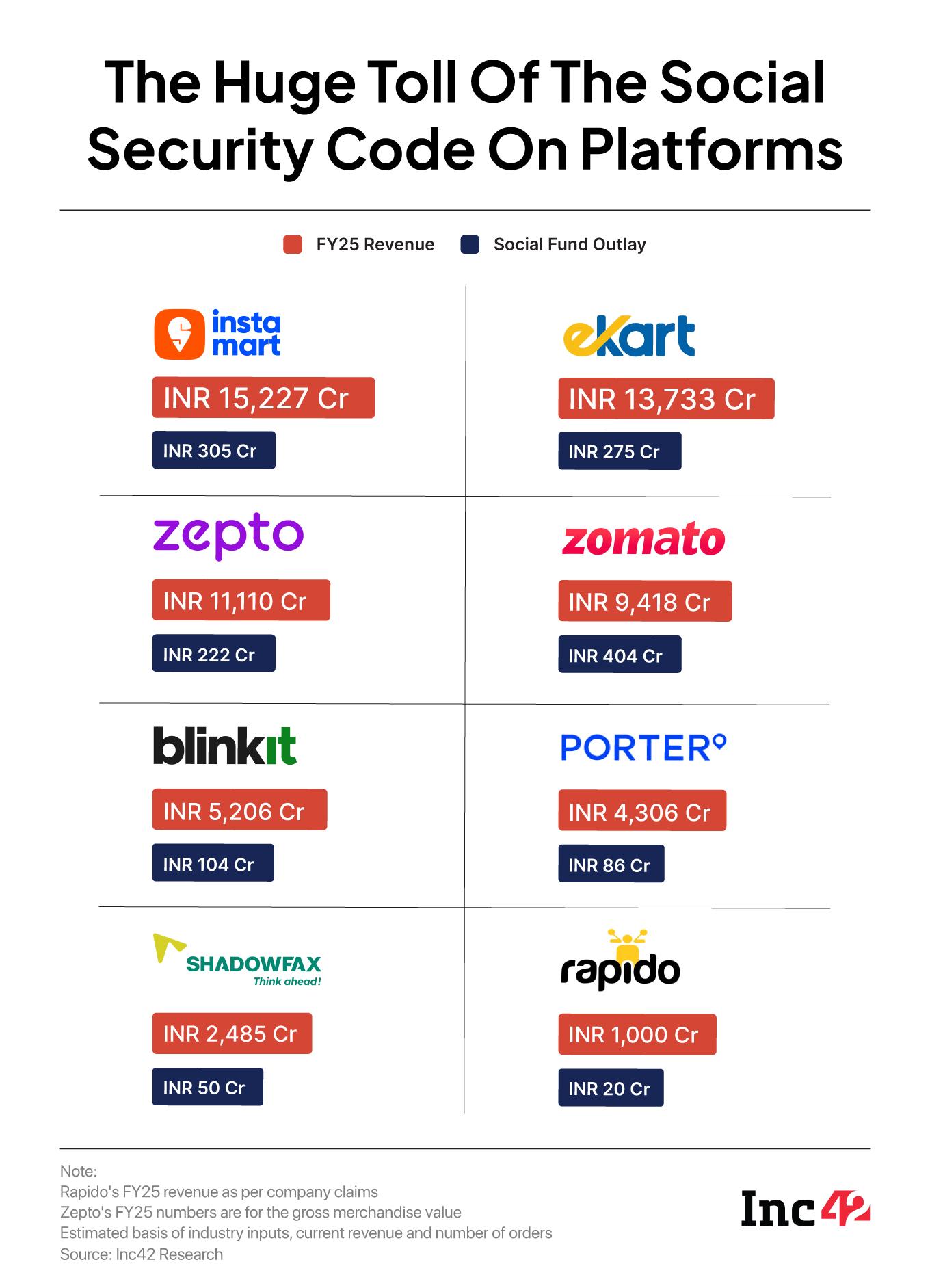
Startups like Rapido, Porter and Zepto are expected to face a glaring impact. Based on its FY25 numbers, Rapido would see an estimated INR 20 Cr annual impact at the 2% social fund level.
Zepto, with FY25 revenue of INR 11,110 Cr, could face an additional INR 222 Cr hit. While Porter, which reported INR 4,306 Cr in revenue, would incur roughly INR 86 Cr.
Taken together with Zomato, Blinkit, Swiggy, and others, the total potential annual impact for major gig platforms exceeds INR 1,500 Cr.
However, with these costs expected to be passed on to customers, it’s the end users who are most likely to be affected.
While the additional labour-code costs may look small on a per-order basis, they become significant, especially in a market where platform fees have already climbed sharply and other customer-facing charges continue to rise. With that said, the final impact will only be clear once the government notifies the detailed rules for implementation.
Edited by Shishir Parasher
The post How New Labour Codes Could Add INR 1,500 Cr Burden On Gig Platforms appeared first on Inc42 Media.


No comments