
Battle For Workspaces: IndiQube Vs Awfis Vs Smartworks
India’s listed managed offices space segment has got more crowded over the past month, with Smartworks and IndiQube becoming the newest coworking solutions providers to list on the bourses.
While three new-age tech coworking space providers are currently listed on the exchanges – Awfis, Smartworks and IndiQube, this number is expected to rise further in the coming months. WeWork India and DevX are two such entities which have already filed their IPO papers with SEBI, while Incuspaze and some others are said to be firming up their public listing plans.
The rush to the bourses comes on the back of a rapid surge in the Indian coworking space market. The market is estimated to reach a size of almost $3 Bn by 2030 from $2 Bn in 2025, clocking a CAGR of 7% due to increasing adoption of hybrid work models and the rising demand from startups, freelancers, enterprises and global capability centres (GCCs).
Amid this boom, the Q1 FY26 financials of the three listed coworking players provided a deeper insight into the market. Let’s take a look at how the three players stack up against each other.
The Divergence In Business Models
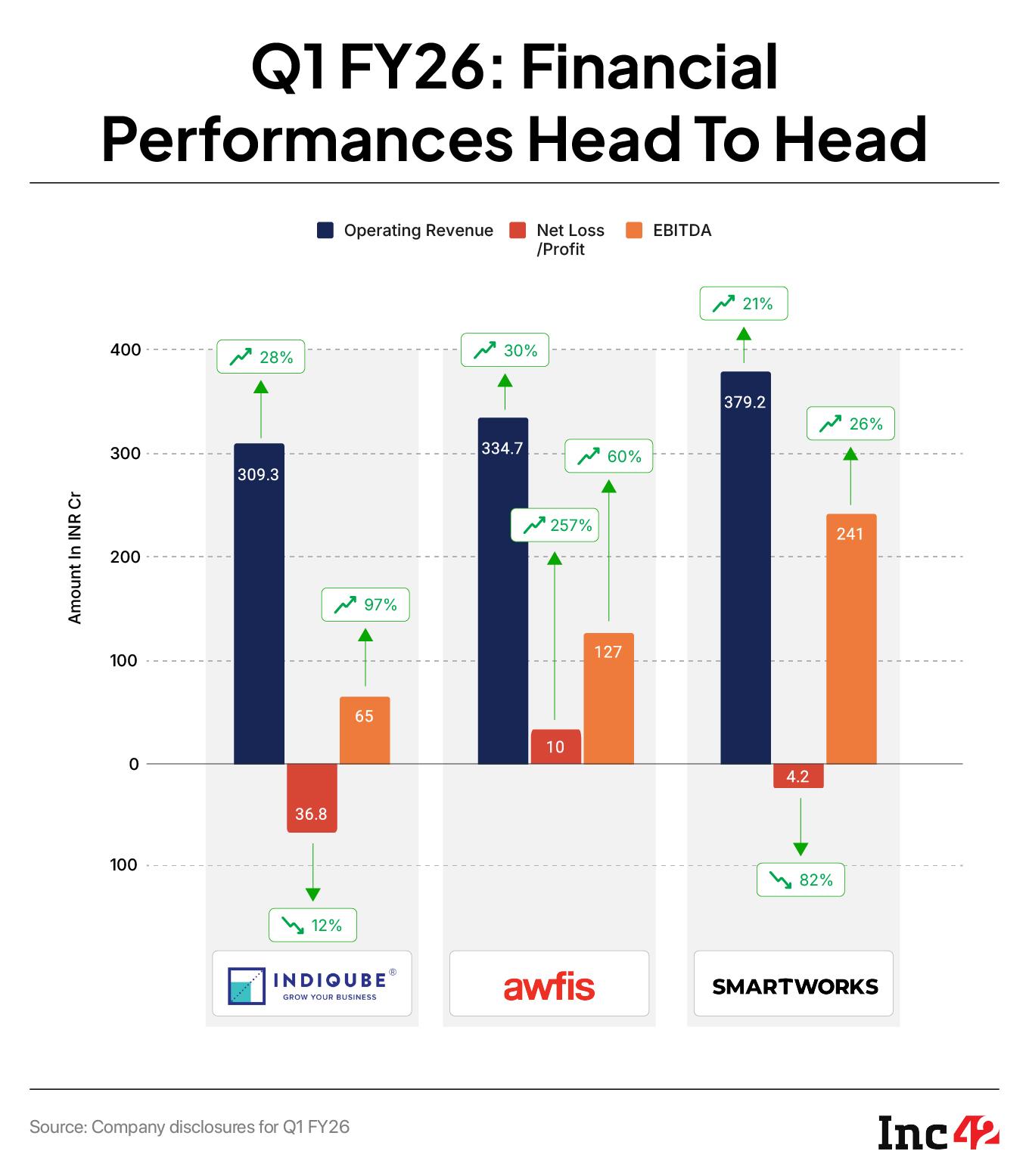
IndiQube, Awfis, and Smartworks have fundamentally different approaches for the coworking market. Most recently listed IndiQube positions itself as a custom-solutions provider through its ‘office-in-a-box’ and ‘IndiQube Bespoke’ strategies. Its model relies on long-term leases – typically 10 years with a three-year lock-in – designed to offer tailored workspaces for enterprises and SMEs.
This requires a deeper level of engagement with clients, from interior fit-outs to a suite of B2B and B2C services like facilities management and transport. While this model requires more upfront capital expenditure, it allows for a strong, recurring revenue base and a high degree of customer stickiness.
The trade-off, however, is the limitation on scalability. As a result, IndiQube has a high concentration of properties in its home city of Bengaluru.
In contrast, Awfis operates with a highly scalable, asset-light model. It partners with developers and commercial real estate companies, allowing it to avoid the heavy capital costs of owning properties.
This model allows for rapid expansion across multiple cities. Consequently, Awfis is present in 18 cities as against IndiQube’s 15. Awfis focusses on providing managed coworking spaces, a model that has proven to be highly efficient in capturing market share and benefiting from economies of scale. The success of this model is evidenced by its large number of active seats and its quarterly profitable streak.
Meanwhile, Smartworks is focussed on leasing large properties and transforming them into expansive, managed campuses. Its strategy is geared towards serving large enterprises and corporate clients who require entire floors or buildings. By operating larger campuses, Smartworks aims to achieve economies of scale.
A Look At The Financial Performance
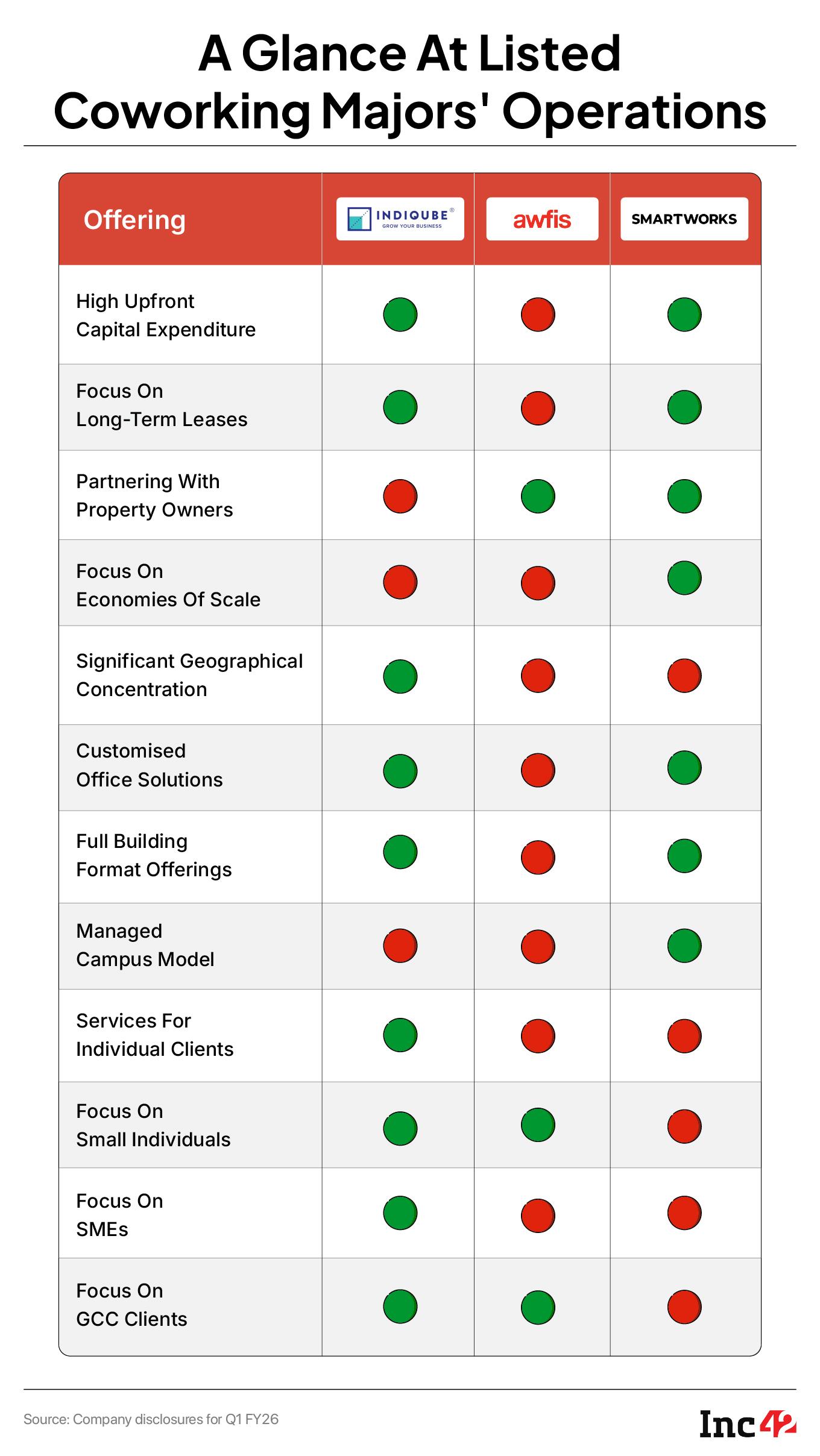
While Awfis was the only profitable company among the three in Q1 FY26, IndiQube and Smartworks managed to reduce their net loss.
In terms of operating revenue, Smartworks led the pack with INR 379.2 Cr. This shows how a focus on large-scale managed campuses and a higher overall seat count plays out in terms of top line performance.
Smartworks also narrowed its loss to INR 4.2 Cr during the quarter, pointing to near-term profitability if the business momentum continues.
Awfis was at the second spot with INR 335 Cr revenue, owing to its asset-light model that generates strong growth. The 30% YoY growth in top line in Q1 was a signal of the strong business momentum, which has persisted since its listing.
Meanwhile, IndiQube was behind Awfis and Smartworks in terms of top line and bottom line. It reported a 12% YoY decline in net loss to INR 4.2 Cr, while operating revenue jumped 28% YoY to INR 242.2 Cr.
However, IndiQube said it was profitable in Q1 as per IGAAP (Indian Generally Accepted Accounting Principles) accounting standards, with a net profit of INR 18.5 Cr. It said its EBITDA grew over 97% YoY to INR 65 Cr in the June quarter as per IGAAP.
Speaking with Inc42, IndiQube CEO Rishi Das gave a bullish forecast for FY26. “Our year-to-year guidance will be at 30% revenue growth. Further, we would be maintaining that we will have a 50% EBITDA growth YoY for the entire fiscal year.”
A Deep Dive In Unit Economics
Breaking down the financials on a per-unit or per-seat basis offers a clear granular understanding of each company’s operational efficiency.
Awfis demonstrated superior unit economics with its asset-light model. With 1.55 Lakh seats and a seat occupancy ratio of 84%, its per seat revenue for Q1 FY26 stood at around INR 25,700. This was higher than its competitors.
Its operating EBITDA margin also was high at 37.8%. The fact that 64% of its seats are under a managed aggregation model, where capital expenditure is shared, enhances capital efficiency.
Its competitor IndiQube is focussed on recurring revenue. Its quarterly revenue per seat was lower than Awfis at under INR 18,853 considering its occupancy ratio of 85%. However, 98% of its revenue was recurring, which gives a clear revenue visibility.
Smartworks, which has the highest leased capacity at 2.32 Lakh seats and had an occupancy ratio of 89%, had a per seat of INR 16,222 in the June quarter. However, the company’s large capacity helps it. Smartworks said its centres achieve breakeven at 65% to 70% occupancy, eliminating asset liability mismatch. A centre generally achieves payback in 30-32 months.
(Edited by: Vinaykumar Rai)
The post Battle For Workspaces: IndiQube Vs Awfis Vs Smartworks appeared first on Inc42 Media.


No comments