
How KiranaPro Is Empowering Local Stores To Stand Strong Against Q-Commerce Giants
When the blazing pace of quick commerce left the good-old mom-and-pop stores scorched with their funds tap running dry and sales freezing, a startup has come up to breathe fresh life into them with the help of artificial intelligence and a parallel business network.
From groceries to beauty products, fashion to gadgets, and 10-minute food deliveries – the wave of quick commerce has swept through industries, disrupting the traditional retail models. The rapid growth made it the centre of attention through the last one year, with startups raising massive funds and newer players joining the fray.
But little has been said over the brunt the traditional kirana stores faced. With declining sales and unsold inventories, many small retailers are grappling with severe funds crunch, with their sustainability at stake.
According to a Deloitte-FICCI report published last year, quick commerce made up about 35% of online FMCG sales in FY24 and the slice of the pie is growing with the platforms reinforcing their dominance.
The All India Consumer Products Distributors Federation (AICPDF) said last October that the rise of quick commerce has forced nearly 200,000 kirana stores down shutters. They were hit hardest in metro cities, with around 90,000 closures. Smaller towns accounted for the rest of the shutdowns.
That was the trigger behind KiranaPro, which connects the customer with their street-corner kirana store through Open Network of Digital Commerce (ONDC), a government initiative in the booming quick commerce space, and the business runs on an AI-based model.
Davids Gear Up To Face Goliath
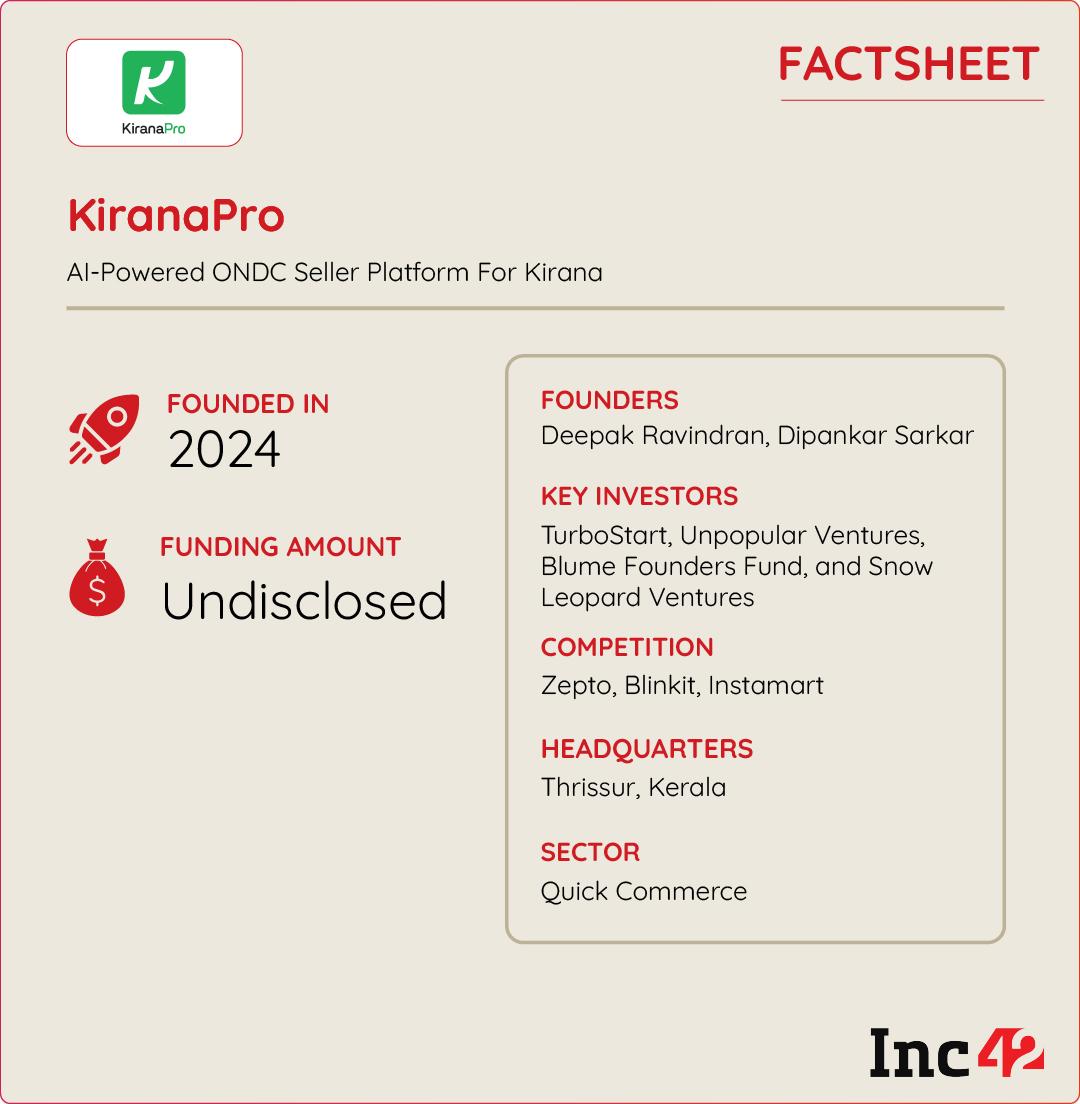
Startled by the plight of the kirana stores, Deepak Ravindran and Dipankar Sarkar, who had been deliberating on how the entire ecommerce model was undergoing disruption, worked out the blueprint to save the traditional businesses.
“Dark stores are rapidly taking over, and it feels like a classic David-versus-Goliath battle. But just like David had a stone to take down the giant, we want our product to be that stone – the one that challenges the status quo and gives kiranas the power to compete,” said Ravindran, who looks after the business growth at the startup.
“At the end of the day, there was a real need in the market. Like they say, necessity is the mother of invention. That’s exactly why we decided to team up and build this.”
KiranaPro came up in 2024 as a bridge between customers and their neighborhood stores through ONDC. It could be a kirana store or a local vendor or any other small business. “Our vision is to build the world’s largest decentralised marketplace for stores, starting with kiranas,” he said.
Ravindran had founded Lookup in 2014 to connect businesses and customers through a chatbot. At the time, commercial chatbots were highly popular among investors and Lookup attracted over $3 Mn. A year later, the company was acquired by NowFloats, which was subsequently sold off to Reliance.
Sarkar, on the other hand, has held leadership roles at Orangewood Labs, Hike, and Nykaa, driving innovation in AI and automation. At Nykaa, he spearheaded the platform’s migration from Magento to a custom-built stack and integrating Python as a core technology. He also played a key role in designing and implementing critical revenue-generating platforms, including the Nykaa Ad Platform and Explore, a social commerce system that provides real-time, personalised user feeds.
The Ease Of Placing Orders
Every store on the KiranaPro platform needs to join ONDC first and go visible on the network. This is when KiranaPro can electronically access that store and enable order placement for customers, Ravindran explained. But before that the kirana store needs to receive updates in real time such as notifications about new orders, instructions on fulfilling them, and information on when someone will come to pick them up.
This entire process is managed through a seller-side application provided by an ONDC partner.
KiranaPro works on the speech-to-cart AI model for order creation. It also supports 35 languages across India, giving the customer the ease of placing the order in the most comfortable way. Whether someone says ‘Mujhe ek kilo chawal chahiye’ or ‘I need to make chicken biryani for four people’, the system instantly understands and builds the right order.
“We have a front-end application – a mobile app or some other integration – that processes voice information from the end-customer. This data is then used to create the shopping cart for the appropriate store within the ONDC network. Once the cart is ready, we make API calls to place the order. If an order is not fulfilled or an issue arises, the software manages these edge cases effectively. The system is designed around our voice AI,” explained Sarkar, who takes care of the technical aspects.
The startup uses large language models (LLMs) that are available, but it is also exploring ways to fine-tune and develop its own AI models. As the startup scales, building proprietary AI models will allow it to generate shopping carts much faster, he added.
Betting Big On Small Cities
KiranaPro is officially live across India. Technically, anyone from any PIN code can use the service because of its integration with the ONDC network. The startup has zeroed in on some cities, with a strong focus on small towns, to promote its services.
“As soon as stores in a given area are onboarded the ONDC network, we can go live there instantly. Unlike traditional ecommerce players who have to launch in specific PIN codes manually, our expansion is seamless because we are part of a larger network of partners actively onboarding stores,” Ravindran said.
While spreading across India is not a challenge for KiranaPro, it does not want to follow a PIN code-based launch strategy. Instead, it wants to make sure that the right partners have onboarded the stores in a given PIN code.
While it was first launched in Bangalore and Hyderabad, KiranaPro’s primary focus is Kerala, where it has spread out to multiple cities. “Rather than competing in oversaturated metro markets like Bangalore, we see a bigger opportunity in empowering kirana stores in smaller cities,” Ravindran said.
The Road To 100 Mn Users
This year, the startup targets adding 100 Mn users and at least 1 Mn kirana stores to its platform. “Just as Paytm scaled rapidly with the adoption of UPI, we believe KiranaPro has the potential to transform how neighborhood stores operate, making digital commerce accessible to every corner of the country,” Ravindran said.
But it’s going to be a bumpy ride for the startup.
For players like KiranaPro, even the small-town markets are heating up with deep-pocket quick commerce Goliaths like Zepto and Blinkit aggressively expanding their reach. Maintaining partnerships within the ONDC network is also a challenge, as store availability directly impacts their service. Any delay or inconsistency in ONDC’s expansion could slow down the growth.
“Convincing the investor was the biggest challenge. Many dismissed the idea, citing the massive capital raised by players like Zepto and Blinkit and questioning how another commerce platform could survive in such a competitive space,” Ravindran recounted.
“Despite the scepticism, we pressed on, ultimately securing a moderate but sufficient investment to build a company that truly works and has found product-market fit.”
While AI-driven voice commerce is innovative, getting users, especially in smaller towns, to trust and adapt to this new way of shopping will take time. However, it is difficult to deny that with its innovative voice-enabled ordering system and extensive language support, it has the potential to revolutionise how consumers interact with neighborhood stores.
Will KiranaPro succeed in democratising quick commerce for smaller businesses as well? Only time will tell.
[Edited By Kumar Chatterjee]
The post How KiranaPro Is Empowering Local Stores To Stand Strong Against Q-Commerce Giants appeared first on Inc42 Media.


No comments